
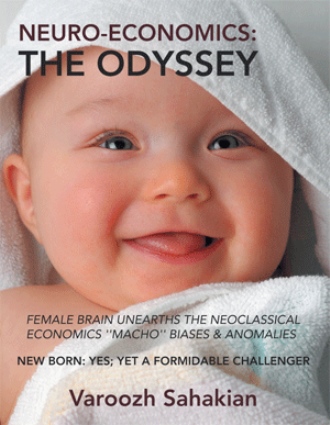
NEUROECONOMICS: THE ODYSSEY
FEMALE BRAIN UNEARTHS THE NEOCLASSICAL ECONOMICS ''MACHO'' BIASES & ANOMALIES
by
Book Cover & Preview Text
Formats

Book Details
About the Book
Of Armenian origin, neuro-economist, Varoozh Sahakian, holds a D.B.A., a Ph.D in Economics and a Ph.D degree in Sociology.
Dr. Sahakian’s disillusionment with the traditional neoclassical top-down economic theory’s approach to the economic agent, “homo-economicus”, along with his belief that the homo sapien’s choice behavior and decision-making is somehow limited to his/her biology (although our environment influences our perceptions and actions as well), or in other words, that economics is actually a part of biology science, motivated him to do extended research and to acquire sound knowledge about human biology, the brain and nervous system, gender differences, as well as genetic, hormonal and chemical functions.
Dr. Sahakian’s book “Female Brain Unearths the Neoclassical Economic Theory ‘Macho’ Biases and Anomalies” is the first of two books the author has written about the newborn, yet, burgeoning field of “neuroeconomics,” a highly promising human science approach to understanding the neurobiological bases of human-choice behavior and decision-making processes.
The author presents a very promising and blossoming scientific field, which portrays a more accurate picture of human nature than neoclassical reductionist, sterile economic theory. In many aspects, the neuroeconomics approach is a positive, constructive one, helping to explain the human capacity for kindness and cooperation and the centrality of fairness to social emotions, morality and norms (sadly by-passed and ignored by many Walrasian, Chicago School, and neoclassical advocates!).
The book most particularly introduces an economic agent who is not necessarily an acquisitive automaton conditioned always to narrow self-interest, like neoclassical economic theory’s unisex (macho) or unsex, but can be a female or male, young or old decision- maker. In other words, the book presents us with a real, “whole human being, a “homo-neuro-economicus”.
The most outstanding initiative of the book is the introduction of a feminist economic theory and its criticism of the neoclassical economic theory. Interestingly this is supported not only by socio-cultural/historical insights but also by neurobiological, psychological, gender, chemical and hormonal evidence as well.
Dr. Sahakian envisions that in the forthcoming years this challenging discipline is likely, once and for all, to realize Adam Smith and David Hume’s dream by providing
“a unified theory of human choice behavior and decision-making.”
About the Author
Armenian origin neuroeconomist, Varoozh Saha- kian, holds a D.B.A., Ph.D in economics & a Ph.D in Sociology. His disappointment with the traditional neoclassical economic theory top-down approach to the economic agent; “homo-economicus,” alongwith his belief that homo-sapines choice behavior & de- cision-making is somehow limited to his/her biology (though our environment helps shape our percep- tions & actions, too), or in other words, economics actually is a part of biology science, motivated him to acquire knowledge about human biology, brain & nervous system, gender differences, genetic and hormonal & chemical functions. The “Female brain unearths the neoclassical economic theory biases/ anomalies,” book is the first of three books the author has written about this new- born, yet, burgeoning field of “Neuro-economics,” a highly promising human science approach to unders- tanding the neurobiological bases of human choice behavior and decision-making processes. The author presents a very promising and blos- soming scientific field, which portrays a more accu- rate and real & candid picture of human nature than neoclassical reductionist, sterile economic theory. In many aspects, neuroeconomics approach is a po- sitive , constructive one, helping to explain the hu- man capacity for kindness and cooperation and the centrality of fairness to social emotions, morality & norms (by-passed and ignored by many Walrasian and neoclassical advocates). The book, after all, introduces an economic agent who is not necessarily acquisitive automation condi- tioned always to narrow self-interest, like neoclassi- cal economic theory’s unisex (macho) or unsex, but can be a female &male, young & old decision maker. In other words, it presents us a more real, “whole hu- man:” A ‘Homo-neuro-economicus.’ The most outstanding initiative of the book is the introduction of a feminist economic theory, its critical approach to the neoclassical economic theory, sup- ported interestingly not only by socio-cultural/histo- rical insights but by neuro-biological, psychological, gender, chemical & hormonal evidence, too. The author envisions, that this challenging disci- pline is likely in the next forthcoming years, once for all, to realize Adam Smith & David Hume’s dream by providing: “A unified theory of human choice behavior and decision-making.”