
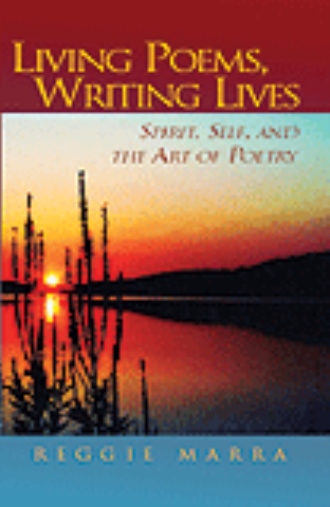
Living Poems, Writing Lives
Spirit, Self, and the Art of Poetry
by
Book Cover & Preview Text
Formats

Book Details
About the Book
Living Poems, Writing Lives engages a poet’s vision, heart and craft in embrace of the art of conscious living. The integration of literary, psychological and spiritual perspectives takes the reader on an invaluable journey of self-discovery. Chapter-ending exercises and meditations, a 15-billion-year time line, and an extensive annotated bibliography complement Reggie Marra’s unique perspective on the roles of poetic devices and imagination in promoting a culture of peace that begins with, and nurtures, an ongoing inquiry into the self.
Poets who feel drawn to look within, and anyone charmed by poetry’s allure, will find a home in these pages.
CONTENTS
Introduction
1 Structure: Knowing Our Foundations
2 The Line: Honoring Episodes and Building a Life
3 Imagery: Juxtaposing Words and Deeds
4 Point of View: Who Are We, Really?
5 Metaphor/(Simile): Life Is (Like) a Gift...a Journey...a Trial...a War?
6 Drama: Recognizing the Reality and Theater of Conflict
7 Diction: The Choices We Make
8 Punctuation: Personality and the Sentence of Life
9 Rhythm: Going With (and Controlling) the Flow
10 Revision: Interpretation, Truthfulness, and the Story of a Life
11 Theme: Big Pictures and Unifying Ideas
12 Texture: Integrity, Quality, and the Overall Feel
13 Completion: Illusions, Endings, and the Denial of Death
Appendix I: Developmental Theory
Appendix II: Time Line
Notes
Annotated Bibliography
Index
INTRODUCTION
The various poetic devices that we use to write and interpret poetry have value beyond the world of the poet. Structure, line, imagery, point of view, metaphor, drama, diction, punctuation, rhythm, revision, theme, texture, and completion are as essential for living a conscious life as they are for writing or interpreting a great (or ordinary) poem. While the book focuses on conscious living, the exercises that conclude each chapter apply to both poetry writing and the search for the True Self, and include basic approaches to meditation. Each chapter first presents the application of its topic to “our poet,” using examples from Shakespeare to contemporary poets; then to “our self,” using, among others, the work of Ken Wilber, Brother David Steindl-Rast, Stephen Levine, and Thomas Merton.
The annotated bibliography at the book’s conclusion lists over 150 entries, including all references used in the book. Appendix I, a brief essay, includes a chart of selected developmental theories, including Piaget, Maslow, Kohlberg, Fowler, Beck and Cowan, and Wilber, among others, which are especially relevant for Chapters Four and Thirteen. Appendix II is a selective time line, which presents significant events, relevant to this book, that have occurred over the past 15 billion years (or so).
The “spirit” and “self” components throughout this book have their foundation in the what has come to be known as an “all-quadrant, all-level, all-line, all-state, all-type,” or “integral” approach. Living Poems, Writing Lives presents a unique path toward recognizing Spirit within.
CHAPTER ONE: STRUCTURE: Knowing Our Foundations explores the possibilities of formal and free verse that are available to our poet, and uses the problem/resolution/uniformity of the sonnet as the primary example of formal verse. Other examples include the cycles and compression of the sestina; the progressive repetition of the pantoum; the self-imposed form of structured free verse; and the potential, freedom and danger of unstructured free verse.
Our self explores her chosen and imposed structures as they apply to issues such as money, time, work and vocat
About the Author
Author of Who Lives Better Than We Do? (poetry, 2001), and The Quality of Effort (nonfiction, 1991), Reggie Marra is a Master Teaching Artist with the Connecticut Commission on the Arts. His Integral Journeys programs foster conscious living and ongoing human growth through the integration of poetry, writing, dialogue, meditation, council, and story (www.integraljourneys.com). An educator for 29 years, including 21 as a teacher, coach and administrator in secondary and higher education, Reggie has shared his work with 2nd graders, grandparents, and virtually every age group in between. He lives in Connecticut with his family—Marianela and Noé.