
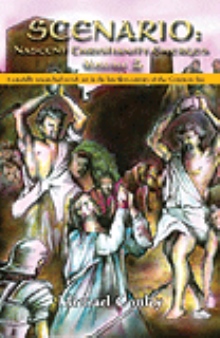
Scenario: Nascent Christianity Emerges Volume 1
A carefully researched novel; set in the late first century of the Common Era
by
Book Cover & Preview Text

Formats

Book Details
About the Book
“Scenario; Nascent Christianity Emerges,” twenty chapters, and an appendage, circa 280,000 words in length. Several chapters of this novel are located in my above website! There's very substantial research and a care for details in my `Scenario which evolved over some ten (10) years of diligent work, placing 1) the world of the late First Century (C.E.) in the Eastern Mediterranean and 2) a number of interacting personages at the time before my reader. Many of them are set upon concocting or interdicting the earliest version of what - in the second century(!) - became the NT I am very much concerned with placing the narrative in a proper, extended, first century setting. a matter largely restricted to the periphery, not only in the four gospels of the New Testament, but likewise in a sea of publications since the later nineteenth.. Correcting this situation means: 1) putting the Romans at the center of the pictures rather than ignoring them till they fit the story-tellers intentions 2) Accepting the very essential role played by Hellenistic Greeks in both Jewish and Roman life in the first century C.E. and acknowledging their decisive influence – either directly or through Hellenised Jews - in the elaboration of Christian dogma and narrative, two fields which achieved their zenith only later in the second century C E. (Rather than speaking of the `Judeo-Christian’ sources of one’s faith, one is closer to the mark when one speaks of its `Judeo-Hellenistic’ framework or, narrowing in on the essence of the matter, to employ the designation, `Israelite-Hellenistic’ (See the four essays on Christianity and the very important essay of Guenter Lueling on the Sabbat in my website: www.thecosmiccontext.de.) 3) understanding an incident in the second quarter of the first century as but a detail in a century-long (!) raging interethnic, but also interregional struggle that drew in the substantial Greek communities and an array of other, largely Semitic, but not Jewish, peoples in the larger region and 4) alerting the reader, not only to attitudes prominent in the period – an essential aspect of this novel - but likewise to the utterly dissimilar visual world in which the narrative evolves. To achieve this end, extensive descriptive matter, regarding building, street scenes and art forms, is repeatedly essential. Putting it in a nutshell, the city of Caesarea pros Sebaste (the double name stressed the importance of its distinctive harbor region) - the location of much of the story - reveals profound difference not only to Peoria Illinois or Times Square, New York, but likewise to Sidney, Australia or Cape Town, South Africa. “Scenario” is in no case a tedious retelling of the life of Jesus. Anything but (!), though his brother, Ya’acov, does lurk in the distance. I’m oriented towards the several decades following the Greek mythology related in the four gospels and – to the extent that this is possible - to the world of real humans with their frailties who set the portentous pace. The events depicted in the Novel occur over a period of fifteen years (70 to 85 C.E.) in large part in the port town of Caesarea pros Sebaste, the seat from which the Romans administered much of the Palestinian territory. I’ve taken great pains to paint a picture of this lively port town on the Mediterranean, well known throughout the Roman world of the First Century. But beyond that, I describe a society which – following a total defeat by the Romans (66- 70/71 C.E.) - is divided within itself. Hellenistic concepts, bolstered up by Roman might, compete with Hebrew thought, roman jurisprudence, and oriental norms for propriety and morality. On top of this, one is confronted with a series of distinctive personalities, impassioned debates and hair-raising adventures. One is acquainted, as an example, with Musaeus bar Unni, a successful baker in town, along with his two wives and their daug
About the Author
A soldier in the US Army, 1944-46, I saw no combat action in the Second World War, but served in the occupation army in southern Germany for one year. My university schooling occurred at Ohio State University, Columbus Ohio. With a scholarship to the University of Utrecht, I returned to Europe in 1953. I taugh for the University of Maryland Oversees Program until 1957 at American military installations in Germany and France (still in NATO at the time) and thereafter assumed a teaching position in the US Army Special Warfare School at Oberammergau, Bavaria. (Doctorate 1960). The Center for Research in Social System (CRESS) in Washington D.C., an appendage of Washington University occupied me till 1969 at which time I responded to an invitation to join a Bundeswehr school in the province of Northrhine Westphalia. I became a German citizen in 1975 and was pensioned in 1986, permitting me to concentrated, first upon the composition of a Mozart opera, as yet unperformed, and beginning in the late 80s, I worked on a novel, now completed, but as yet unpublished. Its title: "Scenario: Nascent Christianity Emerges;" A Novel set in Palestine in the latter portion of the First Century of our Common Era." Twenty Chapters, an Appendix and Bibliography