
Playing to Win
becoming the champion
by
Book Cover & Preview Text
Formats

Book Details
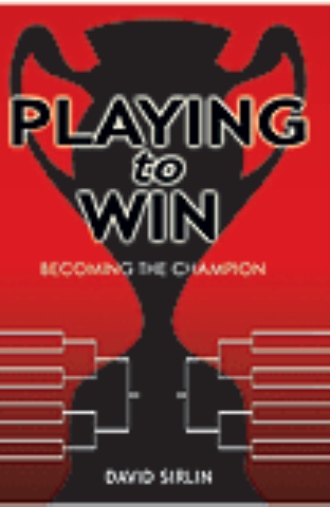
About the Book
This book grew out of a series of articles I wrote for my website, www.sirlin.net. I wrote those articles in order to share the lessons of competition I learned from tournaments in fighting games like Street Fighter. Although I used examples from fighting games, I wrote the articles to be applicable to all gamers with examples from many different kinds of games.
Even within the realm of fighting games, each game has its own community. There are distinct communities for old-school Street Fighter, Marvel vs. Capcom 2, Capcom vs. SNK 2, Guilty Gear XX, Tekken, Soul Calibur, Virtua Fighter, and Super Smash Brothers Melee. Furthermore, I’ve peeked into communities of many other games such as Magic: The Gathering, chess, Counter-Strike, Puzzle Fighter, poker, Scrabble, and more. Each community tends to value its own game above all others and tends to ignore and be generally ignorant of the other communities. And yet I saw that all these communities were so similar at their core: they were all wrestling with the concepts of what “playing to win” really means. They all struggled over deciding which moves to ban from play and how to ban them. They struggled with concepts of “cheapness” and “honor.”
The same arguments raged across the forums and online chats for every game, and even the same personalities were repeated in each community. These arguments stemmed from the basic problem that there are a few different worldviews about how to play competitive games, and no one was clearly voicing the worldview of the most powerful type of player: he who wields the power to win. Those who try to win are wildly misunderstood by the masses, and all sorts of negative things are ascribed to them. In fact, the journey of continual self-improvement that a winner must walk is good, and right, and true…but it’s not for everyone, nor should it be.
The response to these articles was amazing. I’ve been contacted by hundreds of players of all sorts of games I’ve barely heard of. Links to the articles are posted all over the internet, often in forums of various gaming websites. Although the ideas always spark debate, almost every e-mail I’ve ever received on the subject has been of the form, “You’ve changed the way I think about games, thank you Sirlin.” After the constant barrage of thanks I’ve gotten for years now, I finally decided to extend the material, flesh it out more fully, and organize it into one guide for all competitive gamers.
I start with the very basics of choosing a game and how to get familiar with it. I stress the importance of getting connected to the player community and building an environment for yourself that sets you up to succeed. I then give some advice on how to build up basic proficiency in a game.
Next is the tough section that’s hard for people to swallow. The #1 thing holding back most players is purely mental. You must shed all the rules and limitations that exist in your head about how to play, and instead start using all legal moves available to you to win. You must also give up the ridiculous notion that other players should abide by the made-up rules in your head.
I then give my complete retelling of Sun Tzu’s book, Art of War.e shifted his chapters around, omitted some, added a couple, and boiled it down to a few key concepts that apply to most competitive games. It’s difficult to give actual strategy and tactics advice that would apply to almost any game, but there are valuable fundamentals here.
The next section is about formal competition and tournaments. Finally, I close with a discussion of the ethical issues that the very best players face. The power to win is fleeting, but when you have it you can do a fair amount with it. I can’t tell you how exactly to handle the power, but I can lay out your options.
I’ve also noticed some massive misunderstanding
About the Author
David Sirlin is a multiple-time national tournament champion in video games. Part of Street Fighter Team USA, he represented America in an annual international fighting game tournament held in Japan. Sirlin is known (and sometimes teased) for his decidedly simple, yet effective play-style. Professionally, he has been a video game designer since graduating from MIT’s Sloan Business School in 1998.