
The Way Of Pigs
by
Book Cover & Preview Text
Formats

Book Details
About the Book
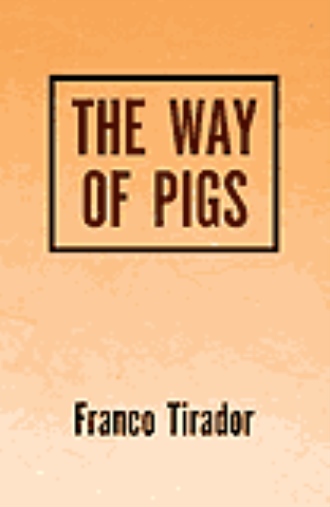
The Way of Pigs is a novel that exposes the hypocrisy of the established political and economic order. It takes place mostly in the fictitious city of “Meami,” controlled by “money” powerful “fastshits” who emigrated from the “furbidden cunttree” after their “asssets” were “cuntfuckscated” by a “Reballution”. It is a Cuban-American literary effort, but more than that, it is an American novel that tries to awake people from their complacency and indifference towards the injustices inherent in a system they accept as the best possible world. It is a satire presenting the madness of the émigré scene in a city that becomes reduced to an insane asylum, with its right wing politics, intolerance and paranoid agenda against a small island. This insanity is a microcosm of the American scene, with its double standards, its repression, its imperialistic foreign policy and its disregard for the wretched of the earth. Flashbacks to other times and places show that it has always been thus. Present day rulers emulate the Nazis and the Conquistadors of the past, while the people’s indifference makes them accomplices to the crimes perpetrated by their leaders. Genocide, human dignity, the bombing of cities, the murder of children, do not interest decent law abiding people as much as the sexual adventures of celebrities. The book’s main character is language itself. It underscores the fact that the everyday language we use reflects the political propaganda the masses are fed through the media, and thus are virtual reinforcers which support the ruling system and confirm the existing oppression as the natural relations of production and distribution. The writer who intends to fight the establishment must begin by attacking the language itself, turning it upside down, as a means of revealing the obscene criminal content hidden under the connotative values of positive terms such as “democracy,” “freedom,” “justice,” “free elections,” “defense,” “liberation,” etc., and what pejorative terms such as “dictatorship,” “terrorist,” “communism,” etc., really mean in the material world oppressed people must face. These words were used by the Nazis to justify their oppression, as they are used today by the present day oppressors. The demythification and demystification of language is accomplished by selecting a vocabulary and a spelling that allow to interpret, not only the statements of characters, but also the narration by the author, at two different levels. The English language is pushed to its limits, both within its contact with the Spanish brought by immigrants, and the subversive components inherently undercover within the standard language of the establishment. The entire book is thus a double entendre where the connotative value of words is extracted from their denotative value. The reader becomes a “ridder” (of the connotations the media propaganda has made him internalize) as well as a “riddler” who must decode the historical references and political messages conveyed by the terms chosen by the author. The language takes precedence over the narration. In other words, the effect of the novel is not what the story tells, but rather how the story is told. The entire book is written with an accent—a sort of “hogscent”—in which words are mispronounced or misspelled in order to confer different meanings and different connotations to the ones of the official language. Words are selected not only for their double and often contradictory meanings—the content or signification—but more so by their form—the expression or signifier—with distorted meaningful components. These constraints on the expression apply throughout the entire work, so that what is contained in the author’s narration and in the statements of characters makes sense at two different levels. An allegory must be maintained at two levels, by controlling the contents of the story, so that it is meaningful at both the literal and allegorical levels. By contrast, The Way of Pigs requires con
About the Author
Franco Tirador was born in Cuba and has lived most of his life in the United States. After residing in several metropolitan areas, he settled in Miami. He was an inmate in a masochistic institution in Massachusetts, where he got his B.S., and got his Ph.D. in Romance Tongues while in Jail. He worked as a chemist, operations manager, physical laborer, teacher, executive of a Fortune 50 company in Mexico and of a Fortune 500 company in Michigan, and became a proletarian—a machine operator—in Florida. He opposes the establishment and denounces the myths fed to the people.