
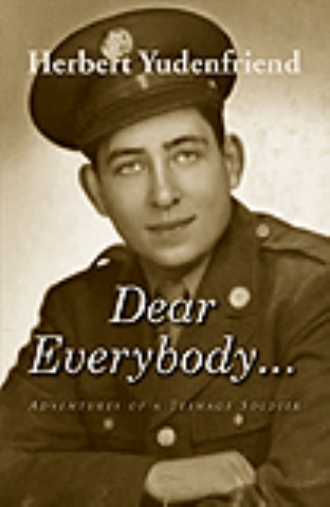
Dear Everybody...
Adventures of a Teenage Soldier
by
Book Cover & Preview Text
Formats

Book Details
About the Book
When I returned home after being discharged from the army in September 1947, my mother gave me a carton containing all of the letters I had written home, in their original envelopes, with the pictures and other memorabilia that came with them. That carton stayed unopened for 60 years, because I never felt any compulsion to read the letters or in any way relive my army experience. In fact, this book might never have been written if it were not for that carton and for the fact that our daughter, Paula Yudenfriend Green, persisted in overcoming my resistance to being videographed with my wife, Minya, for the purpose of describing our life experiences for our progeny. The evening before we were scheduled to be videographed, I opened the box of letters, and read about ten of them. It was then that I realized the need to read all of the letters, and I began the next day as soon as the videographers had left. I was amazed at the amount of personal and American history they contained, especially since all the letters were written when I was between 17 and 19 years old. I was also impressed with their clarity and perceptiveness. I’ve never been the same since I read the letters, and this book is the result. Many things contained in the book were not included in the letters. Events occurred about which I didn’t write, because I didn’t want to cause concerns at home about my physical condition or the potentially dangerous or ugly situations in which I was involved. I have also included clarifications and elaborations of events described in the letters that I think are appropriate to better understand the experiences which I had. After more than 60 years, I have forgotten details of some of the things that happened, and the names of people with whom I had contact, some on a daily basis. On the whole, however, I found that putting this book together was a fascinating journey, and I hope you find it so as you read it.
About the Author
Herb Yudenfriend completed his military service on September 23, 1947. In August of 1950, thanks to the G.I. Bill, he was awarded both bachelor and master’s degrees at Temple University. Next he completed all the academic requirements for a doctorate, but he never finished his thesis. By then he had a family to support. Herb moved on to a career in the glass industry, becoming an expert in safety, security, and energy-efficient glass and window films. He attained many high-profile accomplishments, a few of which are described here. When he was president of Air Seal Insulating Glass Company, for example, he developed and manufactured state-of-the-art units combining security and high-performance, using films on glass for such historic landmarks as the Ellis Island Restoration Project and the Smithsonian Institution. He has been a consultant for the White House, National Park Service, and U.S. Department of Energy. He holds two patents for methodology for manufacturing certified glazing products using applied films. Herb has authored numerous publications and made many presentations in his career. He was honored with the State of New Jersey Innovation Award. The National Institute of Building Sciences bestowed their highest honor on him—the NIBS Member Award. That award reads, in part, “Herb Yudenfriend. . . has been a guiding force in our effort to reduce energy use in homes and buildings. His leadership in developing the concept for an energy rating system for windows, helping to develop the ASTM standard for window installation, and promoting training and certification programs for window installers, . . . [has] advanced national energy efficiency goals.” Herb is still involved as a consultant, researcher, and expert witness in situations involving glass issues. Looking back at his army days, Herb continues to be amazed at the perceptivenessof his teenage letters and the beauty of the piano concerto he composed, never having hadany training in music composition.