
Field Guide to a New Species
A New, Sustainable Way to Be Human
by
Book Cover & Preview Text
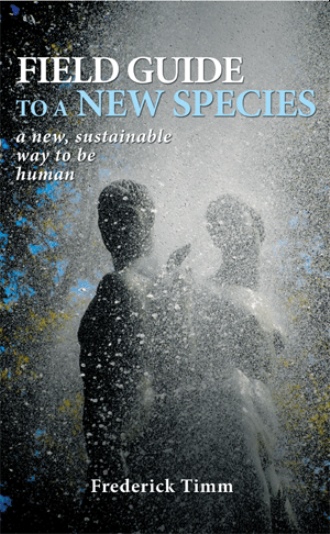
Introduction It is understandable that bacteria, a primitive life form, might devour their host and destroy their own lives in the process. But when humanity, the most conscious and evolved species ever to inhabit the planet, devours and destroys its host—the earth—we must stop and question this act of suicide. As in any suicide, we look for a hidden motive. Why would someone choose to end his or her life? What can’t a person face that would compel him or her to do this? Collectively we must ask this same question. What secret is too painful for our common humanity to admit and buried so deep in the collective unconscious that we ignore the horrifying, global symptoms of ecological and economic collapse that threaten our existence? What are we denying? Who are we protecting? Why do we court our own extinction? Parental and Ancestral Failure The answer is simple but hard to face. Our parents failed us, hurt us and traumatized us, replicating how their parents and ancestors failed, hurt and traumatized them. This is the secret so difficult for us to face as individuals and, collectively, as a species. Our whole species suffers from trauma and many would rather die than admit this tragic legacy. It is heartbreaking to realize that our first loves, mother and father, betrayed us when we were vulnerable children under their care. Only an autonomous adult can admit and heal this heartrending reality. Most people don’t. Most have children instead and pass on this legacy of trauma to the next generation. It is because of this that we humans are ruled by trauma, not truth. This phenomenon is not limited to any culture, race or ethnicity—and nowadays even sexual orientation—but is a global compulsion. In fact, having children is the opiate of the masses and the primary way to avoid facing our inner world and healing our traumatic legacy. Hence our species has created an overpopulated, violent and unsustainable world. What to do? Many of us see humanity’s destructive ways and are appalled. But the ideas needed to change society, even ourselves, seem beyond us. We see the problem but don’t know the solution. Therefore, it’s good to have a field guide to help us understand why we behave so destructively and to teach us a new way that will not only sustain us globally but fulfill us personally. Why a field guide? A field guide is a handy way to identify and learn things about a species in its habitat and to understand its behavior, growth processes, life cycle and survivability. In this field guide, the two species identified are both human and share a habitat—our planet home, Earth. The species are Homo sapiens, which have been around for the last seventy thousand years or so, and Homo veritas, which are just evolving into being. This guide identifies two intermediate types of human as well, Rebels and Seekers, both of which are also described in detail. In essence this field guide delineates four categories of human beings, each in a different place along the evolutionary path to consciousness. The guide investigates how trauma and truth affect the behavior and attitudes of these four types throughout a maturational process that roughly parallels the life cycle. By studying how each type responds to the developmental stages of life’s progression as well as different facets of general living, we can assess ourselves and our degree of maturity, both as individuals and a species. We see who will evolve and survive—and who won’t and why. This field guide illustrates something that we as a species sorely lack: a perspective on our behavior and, more deeply, an understanding of our life’s purpose—our reason for being. Hope for a new species This is a book of hope. Suffused throughout these pages is the message that truth and nature are stronger than the lies of troubled humanity. Some of us are awakening to this reality, this new way of being. We are becoming increasingly conscious of and consonant with truth and nature. We are becoming Homo veritas at last. Living this higher way sends a ripple through the universe that affects the unconscious masses and evolution’s course. One thing we have learned is that it only takes a few to change the world.
Formats

Book Details
About the Book
Why are Homo sapiens a suicidal species? Why do people bring innocent children into this violent, overpopulated world? Why do people ignore the mounting evidence of environmental collapse? Why is humanity courting its own extinction? ••• ••• ••• In addressing these questions, Field Guide to a New Species identifies two species of human—Homo sapiens, which have been around for the last seventy thousand years or so, and Homo veritas, which are just evolving into being. The guide also explores two intermediate types, Rebels and Seekers, thus delineating four categories of human beings, each in its own place on the evolutionary path to consciousness. The guide investigates how trauma and truth affect the behavior, attitudes, and sustainability of each—and, in so doing, provides the reader a self-reflective tool for personal evolution.
About the Author
Frederick Timm is a writer, psychotherapist, and visionary. Since moving to New York City in 1970, he has written radio commercials, taught movement for actors, written and produced off-Broadway plays, and toured the world as a modern dancer with the Nikolais Dance Theatre. Through it all, his primary purpose has been to know himself and evolve.