
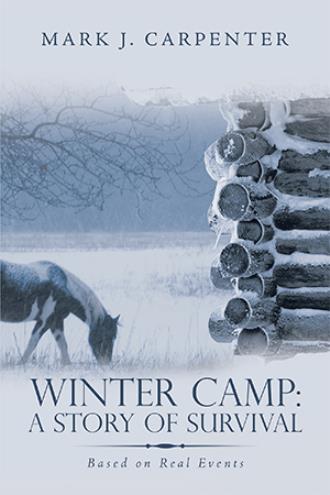
Winter Camp: A Story of Survival
Based on Real Events
by
Book Cover & Preview Text
Frank’s world turned upside down. Literally. Seconds ago, he was comfortably seated in the saddle astride his favorite horse, Rowdy. Their twin puffs of breath came out as tiny white clouds against the cold afternoon. Frank’s eyes were stinging from the glare off four inches of newly fallen snow. He was exactly where he wanted to be. He was on top of the world. What happened? Frank thought, now looking up at the sky from his back. How did I get here? The clear of the blue sky above him was in sharp contrast to the dull fuzziness he felt in his head. Everything had been going so well. After years of pressing his father to let him work the winter line camp, Frank had finally prevailed. Or at least he had succeeded. After the fall roundup in October, Frank had been clearing mud and rocks from Rowdy’s hooves. Father had always said, “You take care of your horse, so your horse can take care of you.” Frank’s father, Arch Sanders, appeared at the edge of the stall. Frank kept working. “You still interested in running the winter camp?” The question came from nowhere, without preface. Frank froze in place, waiting for his father to retract the question or move on to another topic. He didn’t. Frank looked up, still holding Rowdy’s left front hoof. “Are you serious?” Arch nodded. “I need someone I can trust, and I think I can trust you,” he said. “Any ranch hand willing to work and with an ounce of sense has run off to the copper mine. They can make more money there in a week than I can pay them in a month.” The continuation of World War I boosted the demand for copper to the point that the Phelps-Dodge mine near Globe was making money hand over fist. Workers had recently settled a strike for greater pay and went back to work, so almost every able-bodied man under 50 rushed to the mine’s office to sign up for jobs. “I can do it,” Frank said, ignoring the suggestion that the primary reason for sending him might be a lack of any other help. This was his chance. And after three previous rejections to this idea, he wasn’t going to let it pass. Father nodded. “Next week, we’ll go up and spend a couple of days at the camp. I’ll show you what you need to do.” “I know what to do,” Frank said. “I’ve been there before. You already showed me.” “I know you think you know,” his father said tersely and turned to walk away. “We’ll go up next week, and we’ll find out what you really know.” Father stopped at the barn door. “Son, it’s not just about what to do,” he said. “It’s also about being alone. Completely alone. The work at the camp isn’t any different than the work anywhere else on the ranch. But being alone has its own challenge. That you have to learn.” Although annoyed that his father didn’t think he knew enough already, Frank’s heart raced with excitement. He was getting his chance. He cleaned another rock out of Rowdy’s hoof and patted the horse on the leg. “We’re taking the winter camp,” he said. Frank had come to the winter camp with his father two days after Christmas, and the next day the winter camp was entirely Frank’s for two months. Father would return in late February—early March at the latest—shortly after Frank’s seventeenth birthday. Last night, a snow storm ushered in 1918 with a blanket of crystal. Frank thought this was as close to heaven as he could come. But what happened? He was still trying to remember. He could feel the chill of the snow on his back. He knew he should move but couldn’t think why. Then he noticed the pain. His head. His back. But mostly his left leg. What happened? The day started spectacularly. He woke with a sense that something was different. The bite of chill in the air. The whiteness of the light edging in around the curtains. The quiet stillness that surrounded the cabin. One peek out the window confirmed it. The first snowfall! Frank gobbled down a breakfast of dried apples, beef jerky, and coffee. He couldn’t take time on a day like today to cook anything. He slipped on his wool pants against the cold, pulled a flannel shirt over top of his cotton undershirt, threw on his heavy coat and gloves, and rushed to the small barn. He put the bridle and saddle on Rowdy, who stomped his feet with the same anticipation Frank was feeling. The horse's hooves crunched on the new snow, kicking up a ducktail of powder behind him with each step. Everything seemed different covered in snow. Frank thought it was magical. Living in Arizona, even in the mountains north of Globe, every snowfall was an event. The house at the lower end of the ranch got two or three dustings of snow each winter, but the snow never lasted more than a day. Two at the most. Only here at the upper elevation of the 350-acre X-4 ranch—a narrow rectangle of rocky, uneven land unfit for farming but that produced waist-high grass to feed 150 head of cattle and dozens of wild horses—would enough snow fall to last several days. And this part of the ranch was Frank’s for the next two months. He would ensure the safety of the cattle, monitor traps, and maintain fences. He would prove to his father that he was capable. This morning, he followed his normal route, but it didn’t seem routine. Snow on the fence posts looked like tall white hats. Rowdy brushed Frank under mesquite branches that were hanging low with the weight of the snow, creating a miniature snowstorm that coated Frank’s Stetson hat. He laughed and brushed the snow from his hat onto the back of Rowdy’s head. The fences were intact, the traps were empty, the cattle were huddled together to stay warm. Everything was as it should be. Frank took his time, stopping to munch on some raisins before heading back toward the cabin early in the afternoon. Then it happened. Now he remembered. He was looking across the horizon, savoring the contrast of the sparkling snow against the bright blue sky. Rowdy stepped on a rock covered in snow and his hoof slipped. He stumbled and another hoof slid into a slight dip. Frank tried to maintain balance, but Rowdy went down. That’s how I got here, Frank thought. Rowdy fell. He fell on top of me.
Formats

Book Details
About the Book
Sixteen. Alone. Injured. Frank desperately wanted to run his father’s winter camp by himself the year he was sixteen. He could prove to father he was man enough to do anything on the ranch. He was exactly where he wanted to be. Until a freak accident left him wondering if he could even survive. Based on true events, “Winter Camp: A Story of Survival” chronicles Frank’s unexpected adventure alone in the mountains with only his horse, his knowledge, and his will to survive.