
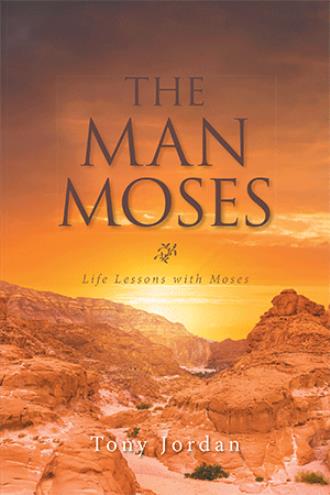
THE MAN MOSES
Life Lessons with Moses
by
Book Cover & Preview Text
13. The Name. Exodus 3 A friend of mine discovered his wife was having an affair with her boss, they had two children, and he loved her, so he attempted to save his marriage. One of his friends was rough, tough, and beefy; he obligingly went around to the wife’s boss with a baseball bat and threatened him with severe injuries if the adultery continued. A few days later, my friend had a telephone call; the caller stated his name; he was the city’s crime lord. He told my friend that “enforcers” were his domain; if he wanted to fight the philanderer himself, that was okay, but not to use other people. Wishing to stay in one piece to care for his children, my friend had to call it a day. It was just a name that stopped my friend in his tracks; behind that name was a criminal empire. Moses also knew the importance of a name. That was why he asked for a name. For hundreds of years in the Christian West, “Jehovah” was used for the name of God. The earliest mention of that name was in the thirteenth century. Years later, the pronunciation was questioned. The mispronunciation came about because Jewish people would not speak aloud the name “Yahweh”. After New Testament times, they added vowels to Hebrew words; to YHWH, the vowels of “Adonai” were added because they would say “Adonai” (Lord) never “Yahweh”. Jehovah is the result of YHWH with the vowels of Adonai. Is it a Noun? Is it a Verb? Most Bible readers know that when Moses asked for God’s name, the reply was, “I AM WHO I AM”. In the time of the Judges, Manoah asked an angel his name, when he promised a child to deliver Israel, the angel replied, "Why do you ask my name? It is too wonderful” (Judges 13:18 NRSV). His name was incomprehensible. If the angel’s name were beyond understanding, how then could we grasp the name of the Lord Himself? It could be that God was saying, “mind your own business”. After all, Jesus put Peter in his place when he wanted to know too much (John 21:22). From the time of Adam, we have always given names to things, whether animals, plants, people, diseases, and more, but surely Moses was overreaching himself asking God for his name. If we were introduced to a Monarch, we would not say to them, “Excuse me, but what is your name?” God is God; he needs no name to distinguish himself from other gods. There are no others. If God had told Moses a noun-name, it would have been added to the pantheon of Egyptian gods, just another name among the hundreds whom the Egyptians dressed and fed every day. Nearby, miners were worshipping Hathor at the entrance to the turquoise mine, but here, Moses was face to face with the Living God; what a momentous moment! When Moses returned to Egypt, the people did not ask for a name. What had he been worrying about? He was looking for problems that were not going to appear. One modern version translates as, “Suppose they ask me your name”. We suppose far too often. Moses was to say the God of our fathers has sent me. A female ancestor of his, perhaps his mother or grandmother, her name was Jochebed (Yahweh is glory), he must surely have known the verb-title of God. When Jesus disclosed his nature and being to the disciples, it was, as so often, by asking them questions, firstly asking what the chatter was, then challenging them to declare their thoughts. Peter replied, “You are the Christ, the Son of the living God”. When Moses was at the bush, he was not asked to declare his faith rather, he was told whom he was meeting, the Living God. Now we have a name! The angel said to Joseph, “Call him Jesus for he shall save …” Jesus said to us, “Whatever you ask in my name I will do it”. In chapters 14,15 & 16 of John’s Gospel, he says we only need to ask the Father in his name. His name is wonderful, mighty, and powerful. It is the name of Jesus we use to cast out demons, heal the sick, pray for provisions, ask forgiveness, and for his presence to be with us. In Mark 16:17, Jesus said, “And these signs will accompany those who believe: by using my name they will cast out demons; they will speak in new tongues” (NRSV). No New Testament scripture says we should use “Yahweh” as a name in prayer, only the name of Jesus. “Yahweh” is never mentioned in the New Testament. Though many psalms originally used “Yahweh” by the 6th to the 3rd century BCE, they were no longer using Yahweh, but “Elohim” for worship, Christians down the ages sing the psalms, but generally transposing Yahweh to “LORD”, as we also pray, “Hallowed be your name”. The Lord hears our prayer when we use his name in our language. He hears our heart’s cry, not our voice, as it says, “They have not cried unto me with their heart” (Hosea 7:14 KJV). It is the character of his being that is behind the declaration of his name, as Shakespeare noted, whatever you called a rose, it would still smell as sweet. Helen Keller was blind and deaf. Her tutor Anne Sullivan introduced her to Phillip Brooks, the author of “O little town of Bethlehem,” he communicated to her about Jesus. She said, “I always knew he was there, but I did not know his name”. “Therefore, God also highly exalted him and gave him the name that is above every name, so that at the name of Jesus every knee should bend, in heaven and on earth and under the earth, and every tongue should confess that Jesus Christ is Lord, to the glory of God the Father” (Philippians 2:9 -11 NRSV).
Formats


Book Details
About the Book
. “The Man Moses” is a perceptive and illuminating discussion on Moses’s life. Written for twenty-first-century Christians who wish to consider ethical and practical problems alongside devotional truths. Engaging with Moses as he confronts the challenges draws the reader to seek God’s solutions to everyday problems. The Bible-based chapters are bite-sized, suitable for daily devotions and thought-provoking life lessons, from Moses discovering his roots, to his epiphany near the turquoise mine, and finally to his vision of the Promised Land from Mount Nebo.