
BIRTH OF BANGLADESH AS CANADA WALKS A DIPLOMATIC TIGHTROPE
VOLUME 1
by
Book Cover & Preview Text

Formats



Book Details
About the Book
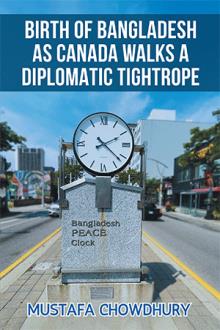
Volume 1 of The Birth of Bangladesh as Canada Walks a Diplomatic Tightrope has six chapters that deal with Canada and Pakistan’s political landscape, a surreptitious military attack, Canada’s reaction, the news media’s role, the Canadian public’s reaction, the role played by Canadian NGOs, and debates in the House of Commons and Senate. Canada believed that any response, one way or another, on Canada’s part, would be “politically incorrect.” Themes such as the preservation of democracy, the transfer of power to democratically elected representatives, the cessation of repressive measures, resolution through constitutional means, and humanitarian assistance continued to dominate the discussion throughout the period the military was in power, revealing Canada’s deep concern as well as helplessness. Canada prioritize the provision of humanitarian relief assistance as its immediate goal, thereby assisting the Bengali victims in India and the displaced people in East Pakistan.
Although the news media, Canadian NGOs, and Bengali-speaking Canadians supported the provisional government of Bangladesh, Canada paid attention to what most Canadians were demanding – that Canada direct its energy to steering the management of the conflict to the United Nations. Canada was interested in determining the best way to help resolve the dispute and promote democracy in Pakistan. An independent Bangladesh out of Pakistan was never on Pakistan’s radar screen. Like the public, Canada favoured a solution that would keep Pakistan as one country in a re-engineered and democratic Pakistan, rather than a split into two nations.
About the Author
Mustafa Chowdhury, a Bangladeshi Canadian, has dedicated his career to academia and public service. His graduate degrees in English Literature, Library and Information Science, and Canadian History have equipped him to make significant contributions to the field. Over his 34-year tenure in Canada’s federal public service, he has worked for several key federal departments and central agencies. His dedication has been recognized with numerous awards, a testament to the value of his contributions. These include the Orleans Queen’s Platinum Jubilee Award and a pin by Marie-France Lalonde, Member of Parliament for Orleans. A crest from Chandra Arya, Member of Parliament for Nepean, acknowledges Chowdhury’s “Service to the Bangla community and beyond.” He has also received the Certificate of Appreciation for dedicated service and advice provided to the Commissioner’s Advisory Committee on Visible Minorities (Royal Canadian Mounted Police, the Vision Award in Recognition of Contributions to Employment Equity (Human Resources Development Canada), the Outstanding Team Award (Treasury Board Secretariat), the Certificate of Volunteer Appreciation (City of Ottawa), the Volunteer Appreciation Certificate from the Government of Canada Workplace Charitable Campaign, the Award of Merit for Volunteer Services from the Ottawa-Carleton Immigrant Services Organization.
Chowdhury’s written works have significantly influenced the fields of interracial adoption initiatives, the Liberation War of Bangladesh, equity, and diversity. His first book, ’71-er Judhoshishu: Obidito Itihash was a pioneering work published by Academic Press and Publishers Library, Bangladesh, in 2015. His second book, Picking Up the Pieces: 1971 War Babies’ Odyssey from Bangladesh to Canada, published by Xlibris, Bloomington, Indiana, USA, in 2015, further expanded on this vital subject. His third book, UNCONDITIONAL LOVE: Story of Adoption of 1971 War Babies, published by APPL, Bangladesh, in 2016, continued to make a significant impact, shaping the discourse in these fields.