
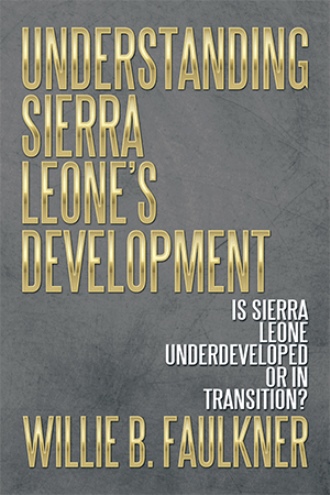
UNDERSTANDING SIERRA LEONE’S DEVELOPMENT
IS SIERRA LEONE UNDERDEVELOPED OR IN TRANSITION?
by
Book Cover & Preview Text
Formats

Book Details
About the Book
This publication, Understanding Sierra Leone's Development, is an author’s dream comes true. Sierra Leone, my birth place is at the core of what this book represents and, in its entirety, is about the country's economic and social ordeals and the problems the government is encountering in trying to resolve them. It premise is developmental and it commences with the author's attempt to arouse the interests and emotions of his readers so as to win their attentions. It contents are reliable, precise and simple, intended primarily for a variety of reading audiences but, in particular, our sixth form and college students planning to enter the business world. There are challenging issues for every-one African, Asian, Arab and other foreign students worldwide, and this is also suited for those whose second language is English. A prelude to the author's introduction enumerates the wave of troubling social events, some of which he considers alien and warns that unless there is the desire of the sitting government to resolve them, they may become obstacles to the country's economic growth. While addressing the country's social problems, the author takes the opportunity, on behalf of his college buddies, to dedicate this publication to their dean (faculty of economics, University of Sierra Leone), the late professor N. A. Cox- George, but to win it reader's emotions, especially the older generation, He idolizes the late governor Clarkson's prayer for Sierra Leone. Chapter 1 is a follow- through but is more detailed in raising the misconceptions of Sierra Leone's traditional values and what they represent. The chapter ends with a call to emulate the lives of the country's departed heroes and illustrious sons, in whose memories the nation should seek spiritual guidance. Chapter 2 is about development and the misconceptions surrounding the meaning itself, it's concept, analysis, scope and whether Sierra Leone is underdeveloped or in transition. This chapter exhaustively addresses it's classifications and characterization and, in doing so creates a new dimension of classification involving development, the super power doctrine, quite distinct from it political interpretation. By creating the doctrine and attaching it to development, it becomes part of the realms of economic development and, by it doctrine, represents a combination of exceptional economic and military superiority. The doctrine is guided by the presumption, that in warfare, economic strangulation and the domination of sophisticated weaponry should suffice to determine the duration or speedy conclusion of a military campaign. The doctrine takes cognizance of the fact that a prolonged war causes far- reaching loss of humans, properties and money. However, there are exceptions: Iran, Pakistan and Israel which according to World Bank, are not yet fully developed. Chapter 3 is about the nation's most controversial socio- economic problems, the land tenure- system, which, archaic by it formation and application, remains an impediment to the nation's economic growth. The obstacles to reforms and how they can be resolved are addressed in chapters 3 4 5 and 6, with recommendations, some improvised with caveats to protect the disposal of communal lands. The chapters on monetary policy, complicated as they may appear, are addressed with the utmost sincerity and understanding of underdevelopment. In Sierra Leone, some of it monetary policies are unwise and tainted with precarious government interventions but, our professional experts themselves have their own sides of the ugly stories. Monetary policy, from my perception of underdevelopment is addressed under three improvised crisis levels,(1) the impotence of Sierra Leone's land- tenure system, (2) a new hypothetical approach called, the Faulkner's tug of monetary war sessions, or the Faulkner's hypothesis and (3) the Bank of Sierra Leone dilemma. Faulkner's hypothesis, When two pa
About the Author
Willie. B. Faulkner, seventy-four years old, a Sierra Leonean Creole by birth and a U S citizen. In 1988, I emigrated to the United States, married with five children and my wife's name is Muna. I am an alumni of the University of Sierra Leone and graduated with a distinction in principles of development economics. In 1971 - 1972, I was recruited by the then governor of the country's central bank, Bank of Sierra Leone, the late Sam Bangura, and commenced work as an executive assistant. Among my fellow recruits was one of my college buddies and bank colleagues, the former minister of finance and current minister of foreign affairs, Dr Samura Kamara. From 1972 to 1988, I rose through the bank ranks to become section head, researve management, in the foreign department, and during my bank tenure, I participated in seminars abroad. At a sponsored Citi- bank seminar in Monrovia, Liberia, my presentation was on international financial institutions, and in 1984, as a guest of the foreign division, Bank of China, one of my memorable moments was my exploration of the Great Wall of China, one of our seven ancient world wonders. In 1980-1986, as a result of incidents of protracted civil unrests nation- wide, their scopes and intensities and being frightful of a potential catastrophic civil war, I reluctantly made one of my most difficult decision in life, my emigrating to the United States to join my younger brother and sister, leaving my mother and children behind. It was a wise decision I later came to realise, because after my departure, tribal and political tensions worsened, with the intermittent closure of schools, to the extent that one's safety and the outcome of the crisis were unpredictable. To support my case, during the course of the civil war, my new building complex in Waterloo was first invaded and rampaged by the pro government force and, later on set on fire by the rebels. In 1994, before the crisis exploded into a full- scale civil war, I returned to Freetown for my late mother's funeral. Back in the United States, after my late mom's funeral, the determination to get our kids to join us became my utmost concern and thanks to the hospitality of this God- fearing nation, in 1996, our reunion occurred and just few months after their arrival in the United States, the civil war exploded. The atrocities were beyond one's imagination and described by CNN and the movie, "Blood Diamond."