
Peering Through The Bushes
A Commentary by Nationally Syndicated Environmental Columnist Edward Flattau
by
Book Cover & Preview Text
Formats


Book Details
About the Book
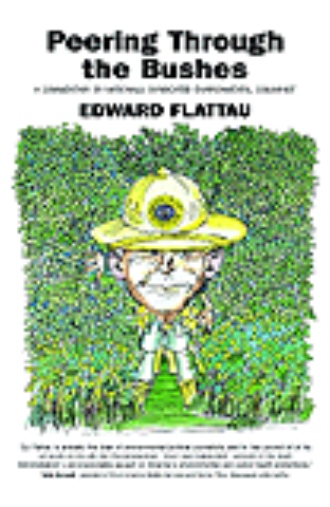
Peering Through the Bushes is a running commentary on George W. Bush’s relationship to environmental issues. Rather than render a detailed documentation of the president’s performance, the book conveys a broad impressionistic picture of the causative factors, current impacts, and future implications associated with Bush’s controversial environmental policies. The author is the nation’s senior nationally syndicated environmental columnist and has been following Bush’s environmental policy-making closely enough over the years to feel comfortable making subjective judgments about the president’s character and motivation on those matters.
Not surprisingly, many of Bush’s environmental positions mirror those of his father’s. But the son strays quite a bit further from the mainstream than Bush Senior ever did. Junior is much more enamored of conservative ideology than his father, and is seemingly even less convinced of the imminence and gravity of environmental threats.
You can thus understand why George W. Bush’s takeover of the presidency has caused environmentalists to greet the 21st Century with trepidation. They have watched with dismay as their issues have been undermined by a discredited conservative ideological approach they thought had been put to rest when Ronald Reagan left office 15 years earlier.
Suddenly, states’ rights, corporate volunteerism, and marketplace incentives were in vogue. Stringent environmental regulation and primacy of federal laws over local ones were out of favor except on the rarest of occasions. Bush gravitated towards an anachronistic unilateral stance on any number of international environmental matters, despite the United States inevitably having to operate in an ever more environmentally interdependent world. His “new” environmental approach had catapulted the nation back in time to the Reagan years, with their embarrassing and sometimes alarming ventures into isolationism.
This was not an auspicious way to inaugurate a century in which humanity can be expected to either restore an ecologically stressed planet to good health or doom earth to an irreversible downward environmental spiral.
The specious rhetoric heard so often during Reagan’s reign was once again emanating from the White House. Preferential treatment in environmental controversies was granted to business interests in the guise of returning some sense of “balance” with natural resources protection. Rationalizations were concocted for opening up previously protected public conservation areas to industrial activity. Brimming with animus at his predecessor’s ideological stance, sexual dalliances, and defeat of his father, George W. Bush was obsessed with rescinding as many of Clinton’s environmental initiatives as possible.
Even after his inauguration, Bush displayed no sign of being able to broaden his environmental perspective beyond preconceived narrowly drawn ideological nostrums Those solutions might be applicable on occasion, but no more than that. Employing the politically correct methodology often appeared more important to Bush than reaching the correct result in environmental controversies. In the wake of the World Trade Center attack, he exhibited no recognition that reversing environmental degradation was a major component of any long-term solution to terrorism.
Unless there is some dramatic change, historians are certain to perceive Bush’s handling of environmental issues in public office as a tale of deception, indifference, and regulatory rollbacks.
Chapter One contains entries in a diary that this author began when the president took office. As you will see, Bush engaged in his ideological vendetta against existing environmental safeguards from the get-go. Subsequent chapters deal with his motivation, character, tactics and ideology. The final chapter speculates on what the future might hold.
About the Author
Edward Flattau began his journalistic career as a reporter in the Albany, N.Y. United Press International Bureau in January of 1962. He became a political correspondent for United Press in New York State in 1964, covering the state legislature and then Governor Nelson Rockefeller. In 1967, Flattau transferred to the Washington United Press Bureau where he covered Congress, various federal agencies, and on occasion, even the White House. In the spring of 1972, he replaced Stewart Udall, former Interior Secretary under President Kennedy, as author of the country’s only nationally syndicated environmental column, which he has been writing to this day. He is the recipient of 10 national journalism awards, has reported from five different continents, and is the author of Tracking the Charlatans (1998), and Evolution of a Columnist (2003). In the spring of 1972, he was chosen to replace Stewart Udall, former Interior Secretary under President Kennedy, as author of the country’s only nationally syndicated environmental column, which he has been writing to this day. He is the recipient of 10 national journalism awards and reported from five different continents.