
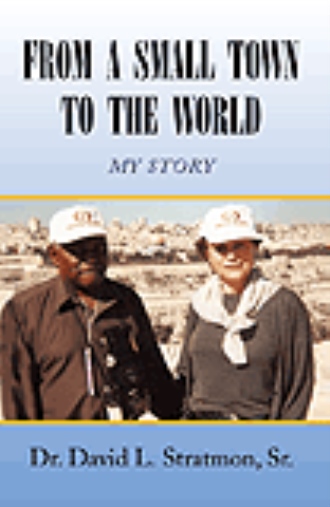
FROM A SMALL TOWN TO THE WORLD
MY STORY
by
Book Cover & Preview Text
Formats

Book Details
About the Book
FROM A SMALL TOWN TO THE WORLD MY STORY By David L. Stratmon, Sr. Ph.D., J.D. World War II Veteran Diplomat US Foreign Service Information Officer FROM THE BOOK COVER On April 15, 1970 several thousand demonstrators stormed the American Embassy in Amman, Jordan. Then they marched across the city to set a fire that severely damaged the library and offices of the United States Information Service. David L. Stratmon was the director of the American Cultural Center located within that building. Dr. Stratmon had been attending a meeting at the American Embassy and he was informed of the disturbance as he emerged from the meeting. When he arrived at the Cultural Center, he approached the leader of the El Fatah and negotiated a deal to pass through their lines to enter the building and search for American personnel. Courageously, he checked all the rooms and exited the building to escape the bombing. His account of this incident and many other interesting episodes are revealed in these chapters. From his early years growing up in Southport, North Carolina, to his accomplishments and trials in Africa, Europe, and the Middle East, he has shown a remarkable ability to persevere and prevail. He has achieved as an outstanding student and he has triumphed as an eminent diplomat. He has weathered the storm of raising four adopted children and two step children. At the game of life, he has won hands down. His moving account is presented in flowing narrative and companion pictures. HUMBLE TO PROUD What sticks out in my mind more than anything else was the poverty of my early years. The fact that I was deserted by my mother at two years old was painful, and the resulting poverty was excruciating. Getting away from it was my primary motivation. Here is an account of how I began that lifelong process. Certainly, times for black folks were exceedingly hard everywhere in those days. Leaving her children behind must have been hard for my mother, Eloise, and it was especially hard for my brother and me. We were hungry much of the time and we were treated poorly most of the time. We lived in a house on Howe Street in Southport with my cousins, the McCoys. Since the McCoys owned the house, they required that my brother and I always enter the back door. My cousin who was my age could go through the front door. We could see the neighbors peering through their windows as James and I went around back while Charles Nelson McCoy, my cousin and playmate, entered the front door. As a matter of fact, all the McCoys used the front door and all the Gordons used the back door and there were a lot of people in the Gordon family. When we got in the house, we could be seen from the living room going to our rooms upstairs. To avoid this dilemma, Joseph McCoy had the stairway rebuilt so that we could enter and exit without being seen from anyone sitting in the parlor or front of the house. This became a constant reminder of who the McCoys were and who we were. I explain my feelings because I hope parents will be inspired to take their roles more seriously, or at least to develop personal habits that will prevent such deleterious consequences for their children. Upon entering my 80s, I still experience painful memories and even more painful to me is the fact that I see the pattern being repeated in many young people. Perhaps I can touch a few by telling my story. WORLD WAR II My two years in the Army got off to an inauspicious start. I reported to the Fort Bragg Induction Center on July 6, 1943. I was dismayed to find that my Infantry ROTC training at A & T College in Greensboro, North Carolina was going to be totally ignored. Although I scored high enough on the Army’s Intelligence Test to become an officer, I was told, rather bluntly, “All we have for you colored boys is work battalions.” Work battalions meant that we weren’t going to see combat action. I soon learned that this attitude was par for the course. I a
About the Author
On April 15, 1970 several thousand demonstrators stormed the American Embassy in Amman, Jordan. Then they marched across the city to set a fire that severely damaged the library and offices of the United States Information Service. David L. Stratmon was the director of the American Cultural Center located within that building. Dr. Stratmon had been attending a meeting at the American Embassy and he was informed of the disturbance as he emerged from the meeting. When he arrived at the Cultural Center, he approached the leader of the El Fatah and negotiated a deal to pass through their lines to enter the building and search for American personnel. Courageously, he checked all the rooms and exited the building to escape the bombing. His account of this incident and many other interesting episodes are revealed in these chapters. From his early years growing up in Southport, North Carolina, to his accomplishments and trials in Africa, Europe, and the Middle East, he has shown a remarkable ability to persevere and prevail. He has achieved as an outstanding student and he has triumphed as an eminent diplomat. He has weathered the storm of raising four adopted children and two step children. At the game of life, he has won hands down. His moving account is presented in flowing narrative and companion pictures.