
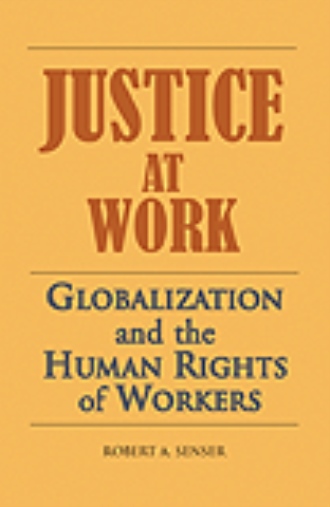
Justice At Work
Globalization and the Human Rights of Workers
by
Book Cover & Preview Text
Formats

Book Details
About the Book
Globalization is in crisis. In Justice at Work: Globalization and the Human Rights of Workers, I explain why that’s so—-and why the Obama administration and the corporate world must take the lead in tailoring globalization to the needs of the 21st century.
The essential requirement of that reform is that it recognize the human rights of workers everywhere. The flagrant failure to do so is to a great measure responsible for the present global economic crisis, which is escalating into a political crisis.
Justice at Work: Globalization and the Human Rights of Workers examines in detail, and from various perspectives, how globalization in its present form protects the rights of business people and business organizations, to the exclusion of the rights of workers and their organizations.
Justice at Workis not a diatribe against globalization or a paean to it. Globalization has a vast but largely untapped potential to improve the lives of all, I contend, but turning that potential into requires requires governments, including the new Obama administration, to act wisely and decisively to make the world trading and investment system fit the needs of the 21st century.
The small group of Americans and British who designed the trade and investment system after World War II did so in order to fill an institutional and legal void in the international marketplace. But they did so very partially, in two senses of the word: partial as in incomplete and also partial as in favoring one group over others.
They did meet the key demands of one important group—-the international corporations, banks, law offices, and allied firms headquartered in the United States, Western Europe, and Japan, as well as the business people involved in the surge in transnational commerce. But the architects of that new system ignored a group essential to global production—-the men, women, and children in the international labor market.
Partiality persists. In fact, it has hardened into a template that is outmoded, inadequate for the 21st century. The rules and structure of the global trade and investment system remain unequipped to promote and defend worker rights and interests as needed in the new global economy.
I argue that it is now up to the United States government, as the chief architect of the present trade system, to take the lead in modernizing it for the 21st century world. I explain that argument in different ways in chapter after and chapter, each supported by specific evidence, such as the failure to end the gross exploitation of women and children in Bangladesh´s globalized garment industry, which exports dresses, shirts, pyjamas, and other clothes to the United States.
During the 17 years that I have worked on this book, I drafted much of it in the form of articles on my own Website, Human Rights for Workers, and articles published in various magazines, including America, American Educator, Commonweal, Dissent, Far Eastern Economic Review, Foreign Affairs, Monthly Labor Review, and U.S. Catholic.
In updated selections from those articles, supplemented by new writings of mine, the book tracks the emergence and growth of three parallel human rights movements-—against sweatshops, for corporate social responsibility, and for fair trade—-and assesses their achievements (and lack thereof). I lace that story with personal comments and information designed to blend the book’s various ideas into a readable whole.
To quote book’s final sentence, “I hope that Justice at Work will stimulate the thinking of readers, and advance their efforts, to make sure that globalization serves people, rather than the other way around.”
See my Weblog, humanrightsforworkers.blogspot.com for reporting new de
About the Author
About the author of Justice at Work Robert Senser started writing—and publishing—articles about worker rights while still in high school. In the past seventeen years his writings, focusing particularly on the human rights of working men and women under globalization, have appeared in America, American Educator, Christian Science Monitor, Commonweal, Dissent, Far Eastern Economic Review, Foreign Affairs, Foreign Service Journal, Monthly Labor Review, U.S. Catholic, and other publications, as well in his Web bulletin, Human Rights for Workers. He draws on that material, and on his fifty years of involvement in human rights (including twenty-one years as a labor attaché in the U.S. Foreign Service), to show how twenty-first-century globalization can—and must—be transformed to serve not only the rights of business and business people but also the rights of labor and workers. Senseredited Work, a montly published by the Catholic Council on Working Life in Chicago, while studying for a bachelor of science degree in evening classes at Loyola University under the GI Bill of Rights.