Mirela Roznoveanu
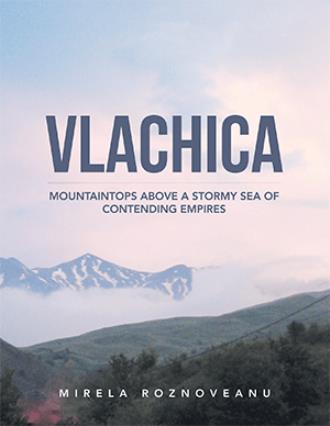
Vlachica- Mountaintops Above a Stormy Sea of Contending Empires
(Xlibris 2021)
Mirela Roznoveanu was already a noted writer, journalist and literary critic in Romania before she left the country in January 1991. Ater coming to the United States, she became a professor of international law research and again a respected writer. Her latest book, a solid novel called Vlachica, was published recently by Xlibris and has already elicited interest and admiration.
Vlachica is a complex and well-crafted book that evolves around several layers of events and is centered on a forbidden love relationship. The plot takes place in the Ottoman-controlled Balkan Peninsula toward the end of the 18th Century. It is a love story wrapped up in many levels of history that unfolds in a maze of geographic places inhabited by various ethnic groups. It is the story of the existence and survival of the little known Aromanian or Vlach ethnic group, a group ethnically related to the Romanians.
Roznoveanu researched many archives and travelled extensively throughout the Balkans to get accurate information for the writing of this epic book. She is using the story line to present a rich and intricate picture of the multiethnic life of the area in a period of dramatic changes. She shows a deep knowledge of the local people and their culture and adds her own profound thoughts on human behavior, customs, religion and politics that shape their daily lives. I asked what prompted her to make such efforts to write this comprehensive book. Her answer was simple, but with deep connotations.
“My mother was Vlach and she grew up in the Pindus Mountains before moving with her family to Romania in the 1920s after the partition of Macedonia, the cradle of the Aromanians, between Greece, Serbia, Albania and Bulgaria. She fascinated my childhood with many stories and legends of her folk, and so did other relatives in the family. I promised my mother to write a novel about the Vlachs and their lives, history and legends and I had to keep my promise…” Roznoveanu also wanted to know more about her ancestors who are so little known in the world and who are now on the verge of losing their language and identity. She sought to make them known to the world.
The novel is captivating, but it is not an easy reading. There are many parallel developments; many details; countless names; foreign words that need explanation, parentheses, real facts and myths combined… All these enrich the lecture, but make the reading rather slow. Yet, the lecture keeps the reader interested and eager to learn more and more about the people and places described in the book. Indeed, a person interested in the area has a lot to learn from a world that has very much vanished. And sadly, one draws the conclusion that in the end every ‘world’ is destined to vanish, including our own.
In short, the story takes place around the evolving love between a young Christian girl, Shana, daughter of the powerful leader of Gramostea, a town located in the Pindus Mountains in Epirus, and Ali, a Moslem Albanian, who is the pasha of the region of Ioannina. Ali Pasha’s request to marry Shana is refused as Vlachs do not marry outside their clans and girls must obey their fathers. Their love, however, is mutual and develops over a number of years. Nonetheless, the end is tragic. In 1788, in revenge and out of rejection, Ali Pasha and the Turkish army assailed the Vlach towns of Epirus and razed their political and cultural centers.
Through the book the reader learns about the struggle of the Vlachs who survived mostly as shepherds and traders from ancient times to the Byzantine Empire, then through the Ottoman times, and later, up to the 21th Century. During her recent travels the author visited some Vlach villages and places that still exist in the mountains of Greece, North Macedonia, Croatia and Albania, where they live in isolation far away from the modern world. The remaining are under the constant assault of their neighbors who are determined to assimilate them. It is nothing new. Vlachs are the original inhabitants of the land and in the past they enjoyed riches and privileges that made their neighbors envious.
Historically, the author writes: “Soon after the Ottoman occupation of the Eastern Roman Empire in 1453, Vlach clans from Epirus made an agreement with the Validé Sultanas, the mothers of the sultans. According to this contract, they were the subjects of the Validé Sultanas only...They paid an annual tribute to the imperial harem and in exchange enjoyed a semi-autonomous status within the Ottoman Empire and would not pay other taxes. Their hard work and successful trade in wool, carpets, highly appreciated cheese (cascaval) and other products, well-known from Istanbul to Venice and Vienna, made them very rich. At the same time, their privileged status triggered the envy and hostility of their neighbors. In the end their success was their own undoing. By the late 18th Century, the Ottoman treasury needed more money and decided to subdue the stubborn Vlachs. By 1788 the Turks attacked and destroyed the richest Vlach towns and strongholds such as Gramostea and Moscopole.
Vlachica is a historical novel accompanied not only by a huge list of references, but also by genealogical trees and geographical maps and an index of names with their pronunciation. Whatever the challenges, the author made it possible for us to see the Armân or Aromanian history as a whole; complex and even ambiguous as it was.
In the final pages, Roznoveanu writes that most Vlachs together with their households and herds took refuge in mythical underground caves and mountain tunnels known only to them. Did they survive? Would they come back again? The author does not tell us. And the novel ends on a dramatic note; the tragic fate of the ‘suicidal dancing ring’ of Vlach maidens was left unknown until the last lines of the novel. The love story between Shana and Ali Pasha did not have a happy ending either. Is the story of life...
When finally, the Ottoman Empire dismembered, every ethnic group in the Balkans became a nation-state, except the Vlachs, who were divided among their neighbors. In the meantime, most of them were assimilated by the new nations, but some retreated up high in the mountains where they continue to live as pastoralists in isolated villages and hamlets. The author visited them and through their tales, ballads, legends and myths offered us this marvelous epic story. For her unique work Mirela Roznoveanu deserves unreserved congratulations. Very good job!
Nicholas Dima, August 2021.