
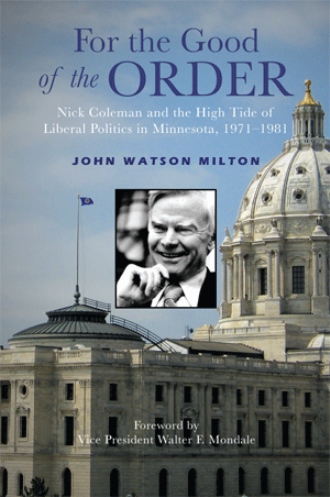
For the Good of the Order
Nick Coleman and the High Tide of Liberal Politics in Minnesota, 1971-1981
by
Book Cover & Preview Text
Formats


Book Details
About the Book
— Walter F. Mondale
For the Good of the Order chronicles Nick Coleman’s role in the legislative cauldron that resulted in Minnesota being
recognized throughout the country as “the state that works.” Despite spirited political challenges, these remarkable
achievements resulted from genuine collaboration from both sides of the aisle. Moreover, the debate over these initiatives
helped raise Minnesota’s legislative branch to coequal status with the executive. Sadly, they also marked the beginning of
the demise of civility, respect, and compromise among lawmakers.
Coleman was an Irish-American, and proud of his heritage. His talent for leadership was surely enhanced by his Celtic
wit and view of the world. No caricature of the Irish pol, however, Coleman used his verbal gifts and charm to offer
reasons why a hesitant colleague could safely follow him when votes were needed for controversial bills. He led from the
front, especially when debate was most intense, and unfl inchingly took the fi ercest fi re from adversaries.
When Nick Coleman left the political arena in 1981, a wave of conservatism was sweeping the country. Since his
departure, much of the agenda Coleman fought so hard to accomplish has been diluted or reversed. Nevertheless, his
legacy remains an inspiration to all who believe that a society should be judged by how it treats its weakest and least
powerful. Perhaps Hubert Humphrey voiced this belief most succinctly when he said, “...the moral test of government
is how that government treats those who are in the dawn of life, the children; those who are in the twilight of life, the
elderly; those who are in the shadows of life: the sick, the needy and the handicapped.”
About the Author
John Watson Milton was born in St. Paul. He graduated from Princeton University and the Woodrow Wilson School of Public and International Affairs; he also studied at the Harvard School of Business. He was elected to the Ramsey County Board and the Minnesota Senate, where he became a recognized leader in health care policy. This led to service on several boards of state and national health and medical organizations. From 1970 to 1992, he worked on political campaigns at the national, state, and local level. Milton has written commentary and editorials for daily and weekly papers, feature articles and investigative reports for magazines, speeches for political campaigns, short stories, poetry, and recipes for several cookbooks. He's a contributing writer for the bilingual weekly La Prensa de Minnesota. His novel, The Fallen Nightingale, won two national awards for historical fiction, and has been re-published in Spanish and Catalan translations. The author lives with his wife, Maureen Angélica Acosta, on a small farm in Afton, Minnesota, where he writes and grows wine grapes.