
Love And Death
An Existential Theory Of Addiction
by
Book Cover & Preview Text
Formats

Book Details
About the Book
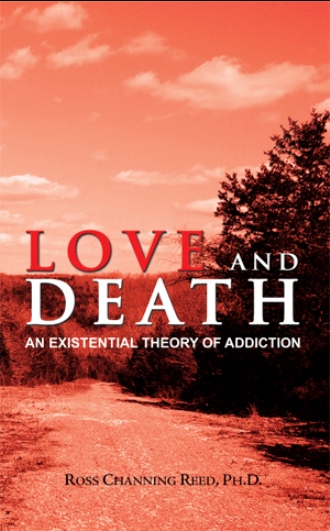
Philosopher Ross Reed, Ph.D., refers to an eclectic array of thinkers in Love and Death: an Existential Theory of Addiction –in particular, existential philosophers Soren Kierkegaard (1813-1855) and Jean-Paul Sartre (1905-1980). According to Dr. Reed, addiction is usually the result of existential or life conditions rather than underlying physiological problems. Therefore, it may involve not only drugs or alcohol but also relationships, belief systems, activities, and even emotional states. Anything that can serve to deflect one’s consciousness from reflectively apprehending the task of becoming oneself can serve as an object of addiction. If the object is another person, one might ask whether in fact addiction can masquerade as love. Is it possible to believe that you are in love with someone when in fact you are merely addicted to him or her? In this creative and provocative work, Reed argues that Sartre’s theory of love is in fact a theory of addiction.
About the Author
Dr. Ross Channing Reed, Ph.D., is a philosopher, author, philosophical counselor and musician. He holds an M.A. in philosophy from Baylor University, a M. Mus. in jazz and studio music from the University of Memphis, and a Ph.D. in philosophy from Loyola University Chicago. He has over twenty five years of teaching experience, having taught courses in philosophy, music, literature and humanities at Loyola University Chicago, the School of the Art Institute of Chicago, Columbia College, Christian Brothers University, and Rhodes College. He has been in private practice for over fifteen years as a philosophical counselor. Dr. Reed is particularly interested in questions related to philosophical psychology and human behavior.