
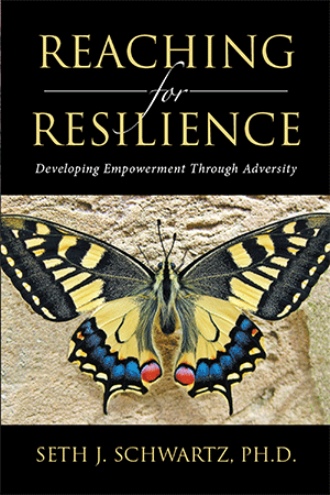
Reaching for Resilience:
Developing Empowerment Through Adversity
by
Book Cover & Preview Text
You might be wondering whether I ever shook my fist at the heavens and asked “Why me?” Why did I have to be the one stuck with this stupid stuttering problem? Why did I have to be the one getting picked on because I couldn’t talk? Why did I have to be the guy who wanted to ask girls out but couldn’t because I was terrified of the phone? Why me? Why me? WHY ME???” It might surprise you that the answer to this question is no. I never asked the Why Me question. It never even occurred to me to ask that question. My stepmother, Barbara, has a wonderful expression that she taught me: Everyone Has Stuff. Everyone has some kind of hangup. Some of us have hangups that are more obvious, like speech problems. But we all have our Stuff that hide in our personal closet – and many of us are ashamed of our Stuff and hope that no one ever finds out about it. The spouse who can’t stop drinking, even though it’s interfering with her/his work and his marriage, has Stuff. The boss who keeps getting angry and yelling at everyone has Stuff. The father who screams at his son for not getting a hit in the Little League baseball game has Stuff. The person who has to have everything in perfect order – or else she will have a panic attack – has Stuff. The question is not whether you have Stuff, but whether you're willing to look directly at it and deal with it. Asking “Why me?” about your Stuff assumes that other people don’t also have Stuff. Believe me, I am not trying to minimize the obstacles you have faced in your life. I am actually trying to normalize it. And further, the fact that you are self-conscious about your Stuff doesn’t mean that other people are judging you for it. Chances are that you are your own harshest critic and worst enemy. I know I am. Other people are too busy dealing with their own Stuff to worry about yours. Always remember that. Most of the time, people spend too much time on their own Stuff to stop and look at yours. As I will explain in just a minute, one of the fastest ways to get out of the Why Me trap is to stop thinking of yourself as a victim. Hopefully you never started thinking about yourself that way, but if you have, I strongly encourage you to stop. Look at it this way: The person whom you make responsible for your Stuff is the only person who can overcome it. If that person is not you, then you’re probably seeing yourself as a victim – and that will get you nowhere. Let me stop and make an important point. Some people are being victimized. People who are targets of domestic abuse are being victimized. Children who are exploited or mistreated – physically, emotionally, sexually, or otherwise – are being victimized. Elders who are neglected and left to die in nursing homes are being victimized. The points I am making in this chapter are certainly not meant to minimize the horrible ways in which children, domestic-abuse sufferers, and elders are being victimized. The first step in these situations is to stop the active victimization so that the person can start healing. If you are being abused, please know that there are resources that you can discreetly contact so that the abuse can be stopped. Most U.S. states, and many foreign countries, have abuse hotlines that you can contact for help. If you know someone – or know of someone – who is being abused, please have the courage to speak up, notify the appropriate authorities, and make sure the abuse is stopped. If you are abusing someone else, please get the help you need so that you can stop. So let me return to my original point. People who are being physically or emotionally abused are victims. I am not a victim. I am someone who has a speech disability, and who is facing life challenges that many other people don’t face. Maybe I was a victim when I was 10 years old and living with an abusive mother, but now that I’m in my 40s and married with two daughters, I am certainly not a victim. Seeing yourself as a victim gets in the way of overcoming the obstacles you're facing. If the person who is responsible for your obstacles isn’t you, then how can you address those obstacles? So if you're asking the Why Me question, consider that it might be beneficial for you to stop doing that. The point is that the answer to the Why Me question doesn’t matter. It isn’t important why you have a debilitating anxiety problem, or why you can’t seem to stop drinking or getting into bad relationships. This is where you are now, so you might as well deal with it. If you do find yourself caught in the Why Me trap, here are some questions that you might want to ask yourself: 1. Is there something that I’m doing that might be at least contributing to the situations that I keep finding myself in? 2. Is there something that I am looking for that is contributing to my being in these situations? For example, am I afraid to make my own decisions, and is that why I keep getting with controlling people who want to tell me what to do? 3. Am I not really trying to avoid, or get myself out of, these situations? If I’m not really trying to stay away from these situations, why might that be?
Formats

Book Details
About the Book
Do you or someone you know face life challenges? Do you struggle with speech issues, anxiety, depression, substance abuse, or other difficulties? Do you sometimes feel as though your life challenges are getting the best of you? In this book, Dr. Seth Schwartz, who has forged a successful career as a college professor despite his struggles with stuttering, shares the techniques and strategies that have worked for him and for others in managing and overcoming life challenges. This book covers taking back control of your life, learning how to get rid of the idea that something is wrong with you, dealing with other people’s judgments and expectations, and developing resilience. Dr. Schwartz also suggests ways to view life challenges as gifts and how to set a course for success. Each chapter includes exercises to help readers apply the material to their own lives.
About the Author
Seth J. Schwartz is a professor of public health sciences at the University of Miami. He has a doctoral degree in developmental psychology. Despite struggling with a stuttering problem for more than thirty-five years, Dr. Schwartz has taught courses and given talks around the world. He focuses much of his teaching and research on adolescents and young adults. He lives with his wife and two daughters in Pembroke Pines, Florida.