
When Demand Exceeds Supply
A Story of Caribbean Private Medical Education
by
Book Cover & Preview Text
Formats

Book Details
About the Book
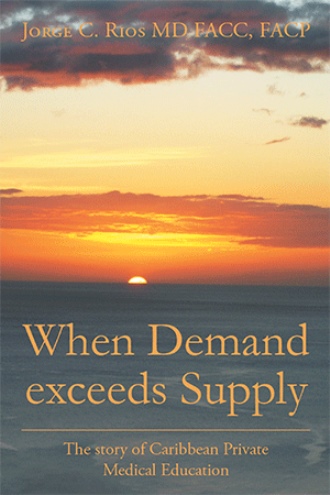
Every year 36,997 students apply, for the first time, for admission to a US medical school, a number that has been increasing over the years. Of these 37,000, only approximately half will gain admission. What happens to the rest? Many have true avocation for a medical career and will search for other options to pursue their dream. Many will search for a second option, a Caribbean medical school. Caribbean medical schools remain an enigma to those most involved in medical education. Many US medical educators may see them as insignificant, a lower-quality version of US medical schools. Dr. Jorge Rios has been an insider in US and Caribbean medical education. He shares candid information about the role that Caribbean medical schools play for both students and the US medical system as a whole. Applicants to medical school will benefit from his insights. His frank remarks will be particularly helpful to students who are interested in Caribbean medical schools as an education option. In addition, the Caribbean schools themselves would be wise to head his advice about how to improve their place within the hierarchy of medical schools. Finally, the book helps those involved in US education to differentiate between Caribbean medical schools and how the US system can benefit from greater alliances with them.
About the Author
An academic educator, the author has served as executive dean at Ross University School of Medicine from 2001 to 2005 and as senior academic advisor to the president for five years and as professor of clinical medicine until his retirement in 2015. Previously, he was associated with the George Washington University School of Medicine from 1971 to 2000. He served as assistant associate and professor of medicine, and in 1976, he was appointed the Eugene Meyer professor of medicine and the chair of the Department of Medicine. He retired from George Washington in 2000. A cardiologist, the author has practiced and taught medicine for four decades and was active in clinical research, having published multiple scientific papers. During his academic career, he has been involved in all areas of academic medicine, education, research, and administration. He is a fellow in the American College of Cardiology and the American College of Physicians. He has been a member of several advisory committees to the National Institute of Health.