
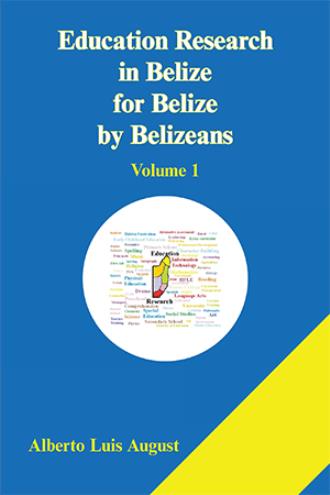
Education Research in Belize for Belize by Belizeans
Volume 1
by
Book Cover & Preview Text
FACTORS INFLUENCING BELIZE DISTRICT PRIMARY SCHOOL TEACHERS’ ATTITUDES TOWARD INCLUSIVE EDUCATION by Maxine McKay Abstract This quantitative study examined factors influencing Belize District primary school teachers’ attitudes toward inclusive education. The study also sought to determine the effect of specific variables on the attitudes of teachers in the Belize District. The study measured 661 registered Belize District primary school teachers’ attitudes toward inclusive education using a 38-item attitudinal survey. The study found that Belize District primary school teachers have varying attitudes toward inclusion. The more serious the disability, particularly those such as Duchene Muscular Dystrophy, Spinal Bifida, Musculoskeletal Conditions, Serious Emotional among other disabilities, the more negative the attitudes toward inclusive education. The findings suggest there are no differences in Belize District teachers’ attitudes toward inclusive education as related to experience of contact, gender, ethnicity, age, and educational qualification. The study also found no differences between teachers’ attitudes and school demographics, namely school location, school management, and school size. However, there were differences in teachers’ attitudes toward inclusion and student with disabilities population (SWD population). Belize District primary school teachers are ardent toward students with disabilities; however, the challenges persist as students with disabilities continue to face marginalization in general education and until there is a mandated attitude change, students with disabilities will continue to be absent from 21st Century education and beyond in Belize. Introduction and Background The success of inclusion depends on many variables, including the attitudes of general educators and the quality of instruction they offer students with and without disabilities (Leyser & Tappendorf, 2001). More specifically, teachers’ attitudes about inclusion have been found to be a crucial factor that impacts the implementation of inclusion for children with disabilities (Bender et al. 1995). Researchers found that general education teachers with more positive views of inclusion have more confidence in their abilities and commitment to accommodate students’ needs in inclusive settings by adapting appropriate classroom materials and related procedures (Campbell et al. 2003; Norwich, 1994). Teachers with more negative attitudes were found to have low expectations for individuals with disabilities (Wilczenski, 1993). Because teachers’ attitudes may influence the quality of instruction student receive, it is important to understand the factors influencing these attitudes. In Belize inclusion or inclusive education is often used restrictively to refer to provisions for children with special needs due to some physical disability (Caribbean Symposium on Inclusive Education, 2007). Today, Belizean teachers are mandated by Belize’s Referendum of Education and the Education Laws to learn to cope with children with HIV and AIDS, diverse learning needs, physical and psychological handicaps, highly negative social circumstances and a host of other challenges. This is because the concept of education in Belize has changed considerably (Caribbean Symposium on Inclusive Education, 2007). The purpose of this study was to examine factors that influence Belize District primary school teachers’ attitudes toward inclusive education. The study also sought to determine the effect of specific variables on the attitudes of Belize District primary school teachers toward inclusive education. The following research questions guided the study: What attitudes, if any, exist among Belize District primary school teachers toward inclusive education? What differences, if any, exist between teachers’ attitudes and experience of contact, gender, ethnicity, age and educational qualification? What differences, if any, exist between teachers’ attitudes and school demographics (school location, school management, school size, and SWD (Students with Disabilities) population)? The study has the following significance: (a.) it will provide data on inclusive education and teachers‟ attitudes in the Belize District, (b.) indicate some variables that may/can affect the attitudes of primary school teachers toward inclusive education (c.) establish the importance of inclusive education training and support (d.) promote the importance of teachers and educators’ understanding of Special Education Laws in Belize and (e.) aid in the application of ways in which Inclusive Education can become more prevalent in Belize. Literature Review The philosophy of education has changed over the past decades. Today there is a greater focus on educating children who come from diverse backgrounds as education is no longer just for those that society want to accept, but for all. Green (2001) suggested that “the term inclusive education is used to describe the educational polices that uphold the rights of students with disabilities to be within the mainstream of regular educational setting” (p. 4). As a worldwide phenomenon, “inclusive education is widely advocated and it is a philosophy as well as a principle and practice that are based on human rights and social justice” (Rombo, 2006). Inclusive education advocates propose that “children with disabilities have to be educated alongside their normal peers in the general education classrooms if they are to get the best possible education” (Rombo, 2006). Under this philosophy, children with disabilities in countries such as the United States, United Kingdom and New Zealand have earned the right to general education (Neilson, 2005), and this philosophy has been the general focus of the inclusive movement around the world. As such it is the belief that “inclusion and participation are essential to human dignity and to the enjoyment and exercise of human rights” (Salamanca Statement, 1994) as the rights of all humans must always be taken into consideration. The effects of inclusion on general education teachers and general education setting are both positive and negative. Some general education teachers may indicate that inclusion has a negative effect because of their already busy schedule with children without disabilities. For these teachers, inclusive education can prove to be overwhelming, especially if there is a lack of training and experiences that can further be compounded by a negative attitude. Jones (2000) found that inclusion can be an overwhelming and painstaking burden for teachers since general education teachers can view inclusion as an increase in their workload in many different ways. A study by Scruggs and Mastropieri (1996) suggested that general education teachers’ views of inclusion appear to alter with the severity of the disability and the amount of extra responsibility required.
Formats

Book Details
About the Book
This book consists of twenty-one empirical studies in the field of education conducted in the Belizean context by Belizean educators. It covers a variety of topics across various levels of education across the six districts in Belize. Each research study article consists of a background that introduces the topic of the study. A brief literature review informs the reader of the conceptual or theoretical framework of the study. The methodology presents the approach, research design, sample, and data collection procedures. The results section shares the raw data collected from the participants. The findings are discussed to bring the study together and it incorporates content from the literature review in the discussion. Conclusions are drawn and recommendations are made as a result of the conclusions. Each study suggests implications for best practices across the different topic areas. The conclusions of each research study can aid in the development of education policies to enhance the Belize education system.