
Readings on Igala People, Land and Language
by
Book Cover & Preview Text
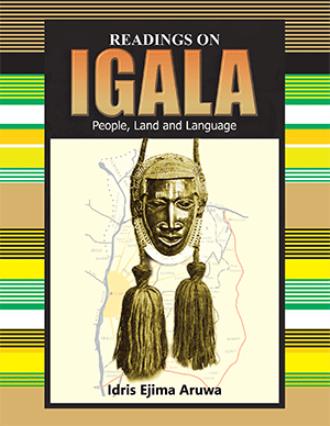
This book is a compendium of the oral traditions, published and unpublished works, cultural practices, rituals and traditional festivals of the Igala people. It is a result of over 20 years of historical research and the enthusiasm of the author. This book focused on the chronology of lgala history by identifying the three major eras in the development t of the cultural and political systems of the kingdom. The book is a fifteen (15) Chapter book. Chapter 1 introduces the title of the book by defining the term "Igala" as a reference to the ethnic group and the language spoken by the people. It is also used to refer to the land in which the people live as "Ane-Igala" meaning Igala land. It discusses the dynamics of the size of Igala kingdom pre-colonial, colonial and post-colonial British rule in Nigeria. The chapter concluded by stating the three main eras in the history of the Igala kingdom. Chapter 2 discussed the challenges encountered by most writers of the Igala history and their different postulation on the origin of the Igala people based on information collected from oral traditions. Most early explorers’ and researchers of lgala history find it easier to tell the history of Igala Kingship, avoiding the complexity associated with the history of the different components that make up the Igala people. The true identity of the people referred to as Akpoto or Okpoto was also presented. Chapter 3, 4, 5 & 6 covers the cultural development and administrative structures of the Igala Chiefdom within Idah and its environs in the years before 16th Century. During this era, the Igalamela clan chiefs were in total control of the leadership institution in a confederacy-style government where the head of the Igalamela confederacy had limited powers and decisions on all important issues are taken in consensus as against the total power attributed to a monarchial system of governance. Each Igalamela chief exercised direct control over its clan and only issues such as dispute resolutions, joint hunting expeditions, farmlands and settlement allocation, security and wars are discussed at the Igalamela confederacy council. The members of the Igalamela clans suffer amnesia of their origin and movement to their present location in Idah. The history of the Nine Igalamela clans and their genealogy is reported based on the collection of oral traditions from the period of the emergence of Ayegba oma Idoko and their role in the establishment of the Igala kingdom. The roles of the Igalamela chiefs had undergone different transformations from the pre-dynastic monarchic era through the proto-dynastic and the dynastic monarchy eras up till this modern day, their roles had been subjected to the whims and caprices of the political powers that be at any point in time, both political and traditional. However, their status as the kingmakers remained unchanged.. Chapter 7 & 8 discussed the proto-dynastic monarchy era (c. early 16th to late 17th century). The events in this era were illustrated in the Certified True Copy of "The Chronicle Sketched Map of the Ata'ate of Igala" collected from the National Archive. These events changed the entire traditional politics, cultural practices and identity of the people that became known as Igala. The foundation of the political development that led to the establishment of Igala Kingdom began in this era. The era started with the Idah-Benin war, the overthrow of the Igalamela clans led Confederacy by the Benin vassal Aji-Ata dynasty in Idah, the emergence of the Kwararafa break-away royalist led by Abutu-Ejeh in the vicinity of Ammagede in the Abejukolo-Ife area of Omala Local Government Area and the rise of the Achadu clan in Igalaogba, Idah Local Government Area of Kogi State. All the individuals that played important roles in this era were discussed. Other Chapters capture the modern era in the Igala Kingdom starting with the rise of Ata Ayegba oma Idoko, his great administrative skills and the establishment of the Igala Kingdom and dynastic monarchy that has remained in place for more than a century and beyond. A Chapter was dedicated to publishing brief profile of the past Ata-Igalas from the Ayegba oma Idoko dynasty. The book aimed to resolve the debate surrounding the sacrifice of Princess lnikpi and Oma-Odoko in the Igala wars of Liberation - which of the wars were these Princess sacrificed? Is it the IgalaBenin war or the Igala-Jukun war. There was an extensive report on the traditional rites of passage to the throne of the Ata-Igala beginning with the funeral rites and rituals of the Ata-Igala and the coronation of a new Ata-Igala. The major exposition of this research is the meaning of the word "Igala". The etymology of the word "lgala" and its meaning has remained elusive to historians and researchers. The word Igala has a tripartite semantic significance. It connotes the Language of the people. It also refers to their ethnic group and the land they occupy. Is there a possibility that the name "Igala" and the spoken language of the people originated from different sources? Using the principle of Onomatology, the meaning of the name "lgala" was analysed. The last Chapter of the book examined the established mode of transfer of power between the lgalamela clans Chiefs and the AtaIgala royal clan led by Ayegba oma Idoko's dynasty. The bond that had sustained the agreement between the Kingmakers' clans, the Achadu oko Ata-Igala, Ata Ayegba oma Idoko dynasty and other Chiefs in the Igala Kingdom. This research work focused on the existing activities of the Igala people and/or the people earlier referred to as the Okpoto (Akpoto) in Idah and the River Niger-Benue Confluence in Nigeria, West Africa. There was no attempt to trace the origin of people to any ancient civilization such as Egypt, Yemen or Sudan. There is no convincing evidence linking the origin of the Igala people to any of these ancient civilizations as at the time of this work. Future research on this subject might reveal the relationships between the Igala people and these civilisations.
Formats

Book Details
About the Book
This book is a comprehensive history of the Igala kingdom (Kogi state, Nigeria), people, land and language based on the study of the oral traditions, cultural practices, articles, published and unpublished works on Igala history. It is a compendium of the history of the Igala people from the Pre-16th century to the present day using the Igala cultural and rituals practices as evidence of historical events. It is a scholarly work on the chronology of the events that led to the establishment of the present dynastic monarchy in Igala land and the creation of the Igala kingdom which became the greatest pre-colonial kingdom in the River Niger-Benue confluence area in Nigeria, with its influence on the cultural, political and commercial developments on the northern Igbo country and along the River Niger down to the Niger-Delta area. The chronology was discussed under three main eras; the Pre-Dynastic Monarchy Era, the Proto-Dynastic Monarchy Era and The Dynastic Monarchy Era. The events that took place in each of these eras were extensively reported. The book illustrates the cultural leadership development of the autochthonous Igala clans, the Benin vassal Aji-Ata dynasty, the Achadu clan and the Empire building escapades of Ayegba oma Idoko starting from his progenitor “Abutu-Ejeh” breakaway from the ancient Jukun led Kwararafa Kingdom. Other subjects discussed include; the real history behind the sacrifice of Princess Inikpi and Oma-Odoko, the funeral rites and coronation rituals for the Ata-Igala and the origin of the name “Igala”. This book is recommended for students of history and those who want to enrich their knowledge on Igala, people, land, language and other related cultural matters.
About the Author
Born at Idah in Idah Local Government Area of Kogi State, Nigeria, Idris Ejima Aruwa is a history enthusiast whose interest in Igala history date back to the 1980s. His interest in the history of the Igala kingdom and people led him to embark on a research that gave him a large collection of archival and historical materials on Igala history. He developed a personal relationship with great Igala historians like Late Dr.Tom MIachi, Professor Joseph N. Ukwedeh, Professor M. S. Abdulkadir and Elder John Idakwoji who mentored him at various times. He has an HND in Electronic and Telecommunication Engineering and a PGD in Computer Science from Federal Polytechnic, Bauchi and the Federal University of Technology, Minna, Niger State respectively. His enthusiasms in history overwhelm his occupation as an Office Automation, Multi-functional Printers and ICT expert. He had worked with several local and international conglomerates in Nigeria. His desire for the advancement and development of humanity and the Nigerian society made him to join politics in 2009 till date. He was a Student Union President, National Youth Service Corps Liaison Officer and a Labour leader. Idris Ejima Aruwa is married with children.