
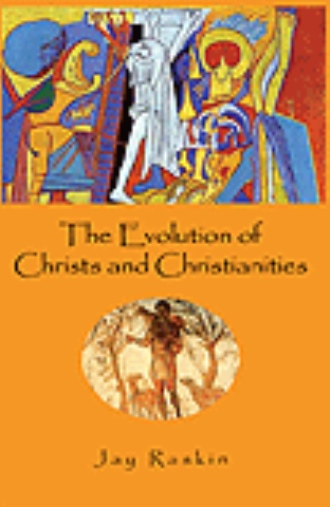
The Evolution of Christs and Christianities
by
Book Cover & Preview Text
Formats

Book Details
About the Book
The Evolution of Christs and Christianities will surprise the most gullible and the most skeptical. It examines the development of the concept of the Christ and the development of Christ movements starting precisely two thousnd years ago in 6 CE. It suggests a startling new answer to the question, “Did Jesus Exist?” It proposes that a woman named Mary created the character of Jesus for a play written around 46 CE. The New Testament Gospels are based on this original play.
The first decade of the 21st century has seen an unprecedented questioning of the origins of Christianity. Works by authors such as Robert Price (Incredible Shrinking Jesus), Bart D. Ehrman (Lost Christianities : The Battles for Scripture and the Faiths We Never Knew),Timothy Freke and Peter Gandy (The Jesus Mysteries), Earl Doherty (The Jesus Puzzle), Archarya S (The Christ Conspiracy), Robert Eisenman (James the Brother of Jesus,), Burton Mack ( The Christian Myth: Origins, Logic, and Legacy ), and Dan Brown (The Da Vinci Code) challenge commonly held assumptions about these origins.
This book similarly challenges many orthodox premises. It examines the possible reasons for the many contradictions, changes and breaking points in the narratives of the books of the New Testament. It deconstructs these texts to suggest an alternative history behind them.
The book offers evidence for five major hypotheses: 1) Bishop Eusebius’ fourth century Church History gives a distorted picture of the development of early Christianity. It gives a fairytale-like account of a triumphant God and Church rather than an authentic history of people and social groups. 2) A woman wrote the earliest layer of the canonical gospel tales. She was probably named Mary and may have been a daughter of a Jewish High Priest. 3) Most of the words of Jesus of Nazareth found in the Gospels of Mark, Matthew and Luke were originally from texts about John the Baptist. 4) Important features of the character of Jesus came from a Samaritan magician called Simon Magus. 5) The major Christian group in Jerusalem, The Church of God, was associated with James the Just and opposed by the Apostle Paul. It apparently made its money by training slaves in obedience for widows. It looked towards Joshua (Jesus) of Nun for salvation as opposed to the laws of Moses, and like Paul, it knew nothing of any Jesus from Nazareth
Taken together, these hypotheses suggest that Jesus of Nazareth was not a real historical person. He was primarily a complex literary creation. He was a combination of various texts about Joshua of Nun, John the Baptist, James the Just, Simon Magus and various other literary characters. However some of these earlier characters may have been loosely based on, or intended to refer to, various historical persons who lived in the first half of the First century.
The author, Dr. Jay Raskin, has a Ph.D. in Philosophy from the University of South Florida.
For more information and orders outside the United States, please go to EVOCC.COM.
About the Author
Jay Raskin has a Ph.D. in Philosophy from the University of South Florida and a B.F.A. in filmmaking from the School of Visual Arts in New York. He has taught Philosophy, Humanities and Film courses at half a dozen colleges in Central Florida in the past ten years. He has produced two feature films (Electra, 1993, and I Married a Vampire, 1984, distributed by Troma Inc, New York City). He has been a moderator at the Yahoo discussion group JesusMysteries for the past five years. He is originally from Queens, New York. He now lives in Orlando with his wife of 20 years, Vicky, and 11 year old daughter, Aphrodite. He currently teaches for the University of Phoenix.