
This is Your Government on Drugs
by
Book Cover & Preview Text
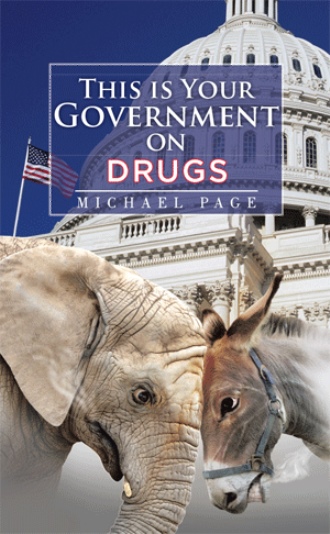
The economic collapse of 2008, while not personally financially debilitating, provided the tipping point for me to begin paying attention and reading extensively on national economic and political issues. Initially inspired by several key writers and commentators, I began to organize my thoughts by topic, listing a number of insights and then casting them in incredulous, sarcastic prose, a la Chicago columnist Mike Royko in the old days. My working title, This is Your Government on Drugs, was a reference to that old War on Drugs television commercial showing a whole egg (“This is your brain.”) and then the egg frying in a pan (“This is your brain on drugs.”). Scrambled eggs might have been a better metaphor, but you get the idea. The course we are on now is so bizarre and twisted that many voters have given up on solutions to the difficult problems that are more desperately needed than ever. Too many people support ideas or positions based solely on party loyalties that are rarely objectively examined, believe ideas that are confidently stated but have no basis in reality, or accept quotes incorrectly attributed to historical figures. And, even more scary, many more people frantically pursue material dreams while chasing the popular culture, completely helpless or oblivious in the face of the overhaul needed in the United States if we are to survive the twenty-first century. They fail to do the simplest things like getting informed and voting to help their own cause. For the purposes of this discussion let’s define a politician as someone who will tell you what you want to hear in order to maximize his/her chances of getting elected and, in the process, raising enough money and support to do the same. Of course, in America, the politician has to first fall within certain philosophical standards of a major political party and pay his/her dues in words, actions, or financial donations necessary to get the party’s nomination. A politician will also change or spin his/her words, views, and actions to fit a specific time, situation, or audience of potential voters. Once elected, the primary goal of most politicians is to get re-elected. They will adjust their view and their vote on legislation in order to maximize their chances of staying in the system. There is an attraction to holding office with the power it brings, abetted by the money and fawning of supporters that goes with it, that rivals that of movie/media stars and highly-recruited athletes. For a majority of politicians the final step is landing a cushy lobbying job. The first step to restoring America to greatness is to fix the government. Yes, it’s broken. What worked for over two hundred years has been broken. And money and land are at the base of the squabbles and feuds that have caused gridlock, just as they were in colonial times when the Constitution was written. The difference this time is the involvement of technology, namely ever-faster and more powerful computers driving the financial and geographical chicanery - such as gerrymandering “safe” electoral districts - that is wrecking our republic. America has become so fixated on, and controlled by, money and wealth that most of us have either forgotten or knowingly chucked aside our founding principles. Those who scream the loudest about going back to Constitutional principles are just as ignorant about the Founding Fathers and the Constitution as those of you who slept or socialized your way through high school Government class. The greatest difficulty in faithfully carrying out the constitutional principles of our Founding Fathers is applying their simple wisdom to the complex, too-connected world of the twenty-first century. Taxes, one of the main factors in our current political disputes, are a necessary evil in a free country that aspires to greatness. This is true - unless the country has an abundant valuable natural resource like oil to support itself - because there are things that are bigger than individuals and groups. That is where we need the government to provide the infrastructure and organizational rules to allow society to run efficiently and effectively, with justice and fairness for all. In America’s definition, greatness requires that the six goals of the U.S. Constitution are met. That demands that all individuals share in the abundant blessings this country enjoys. The challenges we face today of how to wisely spend government revenue are both domestic and foreign, as the two are intertwined. The phrase “guns and butter” was widely used by economists, when capitalism was simpler and truer to its definition, to suggest that countries can effectively spend money on war or spend money on the domestic economy but not both at the same time. Our foreign policy has become greatly muddled by protracted and expensive wars in the middle east where our lack of understanding of local conditions and religious and cultural customs has thwarted our intentions. Social programs include many of the things government does to meet the domestic tranquility and general welfare goals of the Constitution. In truth, most of our social programs are designed to equalize conditions among people and provide a safety net for certain citizens who are disadvantaged and unable to fully take care of themselves. Some would call that redistribution of wealth while others would define it as forming a more perfect union; and that is a key friction point in the current political debate. Much of our current government gridlock comes from the struggle over the size and influence of the federal government. Important issues like taxation policy, foreign policy, health care, education, and so-called “entitlement” programs are key parts of this ideological battle and remain largely unexamined as groups battle to control the direction of public policy. This book explores all of these issues while seeking ways to honestly and fairly solve the issues that are ailing America.
Formats

Book Details
About the Book
This is Your Government on Drugs is a retired history teacher's take on the divisiveness and gridlock that have allowed problems to fester and grow since shortly after the Cold War ended in victory in 1989. The United States has spiraled into deeper debt and lost respect around the world as domestic and foreign problems worsen for lack of serious discussion and the will to do what is best for this country and its people. Safe electoral districts, the influence of big money and the focus on political wins have trumped the welfare of American citizens who fail to show up for elections to effect change by voting for their own interests and those of America.
About the Author
Michael Page is the pseudonym of a forty-year Michigan educator who was born and raised in Flint, Michigan. Michael turned his extensive post-retirement reading and research into observations on the current political climate in the United States and Michigan. His suggestions for ending the gridlock that has plagued our government for over two decades are intended to start conversations and activity that will lead to positive change in America, hopefully by the 2016 presidential elections.