
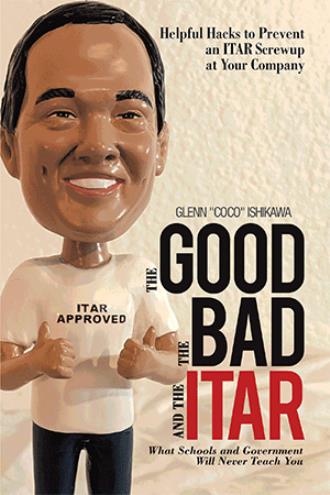
The Good, The Bad, and The ITAR
Helpful Hacks to Prevent an ITAR Screwup at Your Company
by
Book Cover & Preview Text
Not being a professional writer, which will be evident, and never writing a book before, let alone on the exciting world of export controls, that was sarcasm by the way, I first imagined it may be very difficult to come up with content. I was very wrong. To my surprise, once I started, I could not stop writing. In fact, the hardest part I had once I started writing this book was stopping. I will bet any export control administrator that starts to write a book on their export control experiences, their ITAR philosophies, and the compliance issues they face will be surprised how many deep thoughts will naturally flow from their mind. I did find writing this book to be quite therapeutic as I created each chapter and got things off my chest in the first round of the data dump of my thoughts. It was written originally, but not purposely, as a rant and rave of all things I saw wrong in all my years in the world of export controls. My words just came out fluidly and unabated as if I was talking to a therapist. I even had the cliché yet dramatic single tear drop in my left eye form as I dug deep into my export psyche. Nevertheless, I did have to painstakingly reedit each and every chapter to take out my aggressive tone and export control bashing. The result is now a much more focused, kinder, gentler, and even PG-rated kid-friendly read—an export control love story of sorts with a Hallmark ending. Until I heard those fateful words about ITAR not being taught in schools, I never had thoughts to publish a book on the driest and possibly most boring subject ever—export controls. How entertaining could that be? Nobody wants to read about export controls ever. More pathetically, did I not have anything better to do with my life and in the evenings? Go out with friends, parties, movies? Raves? Sadly, I did not. In all honesty, whether this book sells only one copy, in all likelihood to my ninety-two-year-old feisty mother whom I will have to force to buy one and pay her to do so, or ten copies, I don’t care. I feel I have put out there what needed to be put out in the universe about much needed export control awareness, and I am now content with myself after all these years in the export multiverse. Perhaps, this book stands as my own happy Hallmark ending in its own right. I do wish, however, that this book was about me bragging how I became an eccentric music producer mogul. Since I love music, growing up playing instruments and playing in different bands, and love to record my own terrible music arrangements, I did have real dreams of being a hip-hop and rap music producer and even had an interview twenty years ago for a job with a major music label. I sent resumes to the likes of Sony, BMG, Warner Brothers, Atlantic Records, Interscope, and even Death Row Records. The interview went well, but afterward, it was one of those “almost” moments. I remember speaking to the company I interviewed with soon after and was advised I was number 2 on the hire list. If the first person didn’t accept their offer, I would get the job. That second call never came in, and here I am writing a book on export controls. I always wondered who that other person was. I think it may have been Dr. Dre. According to that crypto commercial with Matt Damon, he said the world is filled with “almosts.” My preamble above is just my way of saying everyone has a story, and everyone most certainly has an “almost” story. I would love to hear your “almost” story and what brought you here. My work experience is definitely rocket- and space-centric and primarily ITAR focused. It is truly an exciting time in this New Space generation, and I’m glad to be smack in the middle of it. I have worked at three major rocket launch service providers and a NASA prime contractor. I have also held many different titles— export compliance adviser, global trade compliance specialist, and export licensing specialist. Unfortunately, rap mogul is not one of the titles I’ve held yet, and I have come to terms that I won’t be meeting Ariana Grande anytime soon. I have always thought the perfect title for any person working export controls should be ambiguity control specialist (ACS) because you constantly live, work, and manage within the world of gray and ambiguity. With so many titles and job changes, it may appear I can’t hold a steady job, but I was fortunate to see how certain space companies operate their export controls differently, which gave me much content for this book. In closing, I do feel lucky to have been in the space industry for as long as I have because commercial space today is an exciting place to be at this time and place in history. I didn’t say easy. I was there when the space industry was “old space” and somewhat stagnating in the mid-2000s, and there was no such term yet as New Space. I remember when launch mission managers were telling me customers were not launching as much as before and things were starting to get slow. This was before the time of today’s much smaller format spacecraft and payloads such as small-sats, nano-sats, cube-sats, and micro-sats launching on small to mid-size launch vehicles, a rapidly growing segment. Only fifteen years ago was a time of primarily very heavy and very expensive spacecraft payloads and heavy lift rockets. Things have changed; times have changed. It is a transformative time to be in commercial space. Nobody ever said doing great things will be easy. If the New Space industry today had a motto, it should mirror the state motto of Kansas, “Per aspera ad astra,” which is Latin for “with much hardship to the stars.”
Formats

Book Details
About the Book
This book is purposefully void of any actual export regulations. The book simply aims to provide export control awareness and helpful tips across the board for any company and any person in the aerospace and defense industry to mitigate chances of export violations. This simple and fun read, which uses occasional pop culture references to drive home a point, will attempt to not only explain not only why export controls exist but also ingrain the philosophy of ITAR controls in everyone’s mindset for it to be a seamless part of your work landscape. It provides a macro view on those sensitive and possibly exposed areas for you to reevaluate and better protect your technologies and hardware from unauthorized access. This book is not an internal control plan for your company but may provide ideas to help identify and turn over some compliance stones previously left unturned. The goal is to increase export intelligence to all employees of a company manufacturing export-controlled commodities and to prevent that dreaded and soul-sucking export violation.