
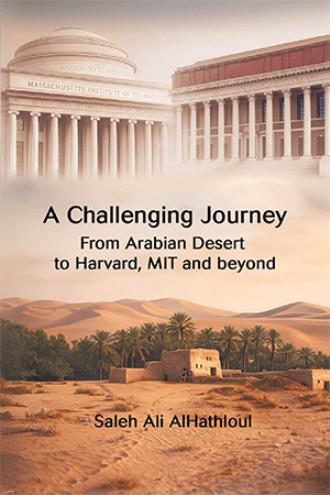
A Challenging Journey From Arabian Desert to Harvard, MIT and Beyond
by
Book Cover & Preview Text
I took Dr. Khaled’s phone number and called him. He told me that he was working at the time in the Ministry of Municipal and Rural Affairs (MoMRA) and that His Excellency, the Minister of MoMRA, Ibrahim Al-Angari, wanted to meet me. Accordingly, an appointment was made for me with the Minister the next day. I went to the ministry’s headquarters in Al-Nasiriyah shortly before the appointment. I went to see Dr. Khalid Al-Angari in his office and greeted him. He called the Director of the Minister’s Office, Eng. Ali Al-Hassoun, and informed him that I had an appointment with the Minister. Then he let me go to Al-Hassoun. I was familiar with Al-Hassoun, as I had contacted him during my PhD studies in the late 1970s while collecting research information. At that time, Al-Hassoun was the Riyadh Municipality’s coordinator for a project to update the master plan for Riyadh, which was being carried out by SCET- International Sides. He helped me greatly during that stage, as he provided me with copies of reports and studies prepared by the consultant. On my way to Al-Hassoun’s office, a question came to mind: what did the Minister want from me? I arrived at Hassoun’s office, and after a few minutes, he escorted me to the minister’s office. Once we entered, he left. His Excellency, the Minister, received me with a warm handshake greeting while standing behind his desk, asking me to be seated in the chair in front of him. The minister continued welcoming me warmly. Whoever dealt with him knew that he was very humble and sincere. Then he moved on to asking about my work, my participation in committees, my studies in America, etc. At the beginning of the meeting, I was the main speaker, and then the minister started talking about the ministry, its work, its efforts to advance the municipal bodies, the need for young, talented people, etc. I was listening to him and didn’t understand what he meant. I naively replied that it was my honor to cooperate with those working in the ministry as a part-time advisor and that I would put all my knowledge and experience – still little – at their disposal and would do my best to help and contribute as much as I could. “No, no. I don’t mean that you work with us as a part-time advisor. I’m suggesting that you work with me as a Deputy Minister for town planning,” he said, then paused and looked at me. I remained silent for a while. “What do you say?” he asked. I told the Minister that I had not thought – since I was appointed as a teaching assistant at the university in 1392 A.H./1972 and took the path of postgraduate studies and research – that I would leave the university one day, so it was difficult for me to answer at that moment. I asked him to give me two weeks to think about the matter and reach a final decision. He said that two weeks was a long time. So, I agreed to come back to him within a week with a definitive answer. The interview meeting, which I had not been prepared for, took about twenty- five minutes. I left the minister’s office, and an inner turmoil swept over me: who was I to refuse this position that I would never attain on my own, no matter what efforts I might exert? I walked and didn’t know how far I walked or where. But I remembered something important; that is, I didn’t thank the Minister for his confidence in me. Thoughts swayed in my head about what I should do. How could I decide on the matter? It would be a decision that could change the course of my life and the future that I had drawn for myself for the previous twelve years. I do not remember if I went back to the university or went home. After getting tired of thinking, I decided to consult some colleagues and friends who had experience leading administrative and governmental work. In our heritage, it is said: Advice is ever wanted. I called Dr. Mutlib al-Nafisah, who made an appointment for me to visit him at his home over the weekend. I had a good relationship with Dr. Al-Nafisah since we were fellow students at Harvard between 1973 and 1975, when I was studying for a master’s degree at the Graduate School of Design and as he was preparing his doctoral dissertation at Harvard Law School. I talked with him about several issues before speaking about the offer made to me to work as a Deputy Minister of MoMRA. I asked him for his opinion on this matter that was preventing me from sleeping. He began analysing the situation for me and showing me the advantages of working in the ministry, saying that this would give me an opportunity to gain practical experience in the same field of study and that I would not leave the university permanently but would continue to teach even one subject per semester. At the end of the meeting, he advised me to put my trust in God and agree. During the past thirty-five years, I have firmly believed that Dr. Khalid al-Angari is the one who nominated me for the post. But upon writing these memoirs, I phoned him. At that time, he was the Saudi ambassador in France. I wanted to thank him for nominating me to work with the Minister of Municipalities and ask his permission to mention that in my memoirs. “No, I am not the one who nominated you; it was Dr. Mutlib al-Nafisah at the Council of Ministers’ headquarters who suggested your name to Shaikh Al- Angari. The Minister asked me about you, and I seconded Dr. Al-Nafisah’s nomination of you,” he said. Hearing this, I could not help laughing. “Why did you laugh?” Dr. Khalid wondered. I told him that because the first person I consulted and asked for his opinion and advice on the matter was Dr. Al-Nafisah himself, and that after I met with him for more than two hours, he persuaded me to accept. But throughout all these years, he never mentioned that he was the one behind my nomination for the post. Not only that, but I also contacted Dr. Saleh al-Athel, the then King Saud University’s Deputy Rector for Postgraduate Studies and Research, for advice and opinion. Dr. Al-Athel had earlier assigned me to coordinate and follow up the design project for the university campus in Qassim. He also nominated me as a part-time advisor and a member of the technical committee of the General Organizations for Social Insurance, of which he was an active member at the time. Dr. Al-Athel’s opinion was clear from the moment I informed him—that is, to accept the offer without hesitation. I also opted to hear from a third party. I somehow knew Mr. Abdullah al-Naim, the mayor of the city of Riyadh, since I worked as a part-time consultant for the Arab Urban Development Institute under his chairmanship. I also participated as a jury member in several architectural competitions for Riyadh municipality projects. I wanted to hear his advice for two reasons: first, to know his opinion on the idea of moving on and how he saw it; second, I wanted to know something about the man I would work with, Shaikh Ibrahim al-Angari, if I decided to accept the offer. Mr. Al-Naim encouraged me to move on, saying it would be an opportunity for me to develop the Town Planning Agency. He also made it clear to me that Shaikh Al-Angari was one of the best leaders and a clear, frank man. This was what I really felt during my interview with him. Mr. Al-Naim also assured me that the Minister would certainly support me, as he was the one who had chosen me as his deputy.
Formats

Book Details
About the Book
"This is an autobiography that is not only compelling but also remarkable for two main reasons. Firstly, it represents an extraordinary model of struggle and success. Secondly, it s more than just the story of Dr. Saleh AlHathloul; it reflects the transformation of an entire society and the unprecedented changes in Saudi Arabia's history during the lifetime of one individual." Ibrahim al-Bulaihi, Saudi thinker and social critic A Challenging Journey "is a tale of perseverance, dedication, and modesty of an architect, planner, and academic who has witnessed and contributed to the urban and architectural transformation in Saudi Arabia over the past four decades. From an orphaned, destitute boy in Al-Badayea to an influential leader, Saleh AlHathloul's inspiring journey is a testament to the high ambition that drove him to leave a lasting impact on generations to come." Mishariy al-Naeem, Al-Riyadh newspaper "Autobiographies are scarce in our society, and if found, they often focus on successes and reflect pride in career positions and achievements, omitting hardships and the impact of place, family, and the transformation of society. AlHathloul breaks this mold, sharing a deeply honest account of his rise from mud houses, barefoot childhood, and sand classrooms to the pinnacle of academic and professional success." Amr al-Amri, Al-Jazirah newspaper "This autobiography is a work of beauty, sculpted from time and memory, guided by a benevolent spirit that captures the details of the journey with both an innocent eye and bold language. Dr. Saleh AlHathloul's sincerity elevates his narrative, allowing readers to connect with the often-overlooked stories of a life lived. This is a life journey, arduous yet recounted with ease, in a language that reveals the beauty within the author's heart." Ibrahim Daoud, Egyptian Poet