
BIRTH OF BANGLADESH AS CANADA WALKS A DIPLOMATIC TIGHTROPE
VOLUME 2
by
Book Cover & Preview Text

Formats



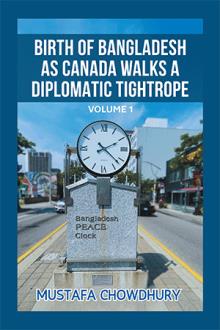
Book Details
About the Book
Volume 2 of The Birth of Bangladesh as Canada Walks a Diplomatic Tightrope comprises four chapters that examine Canada’s initiatives, its dilemmas, a chronological account of its diplomatic measures, and the recognition of Bangladesh immediately after its birth, as well as the allocation of resources to rebuild war-shattered Bangladesh. Due to her policy of non-intervention in the internal affairs of another country, Canada did not want to be directly involved. Canada was outraged to see how Sheikh Mujibur Rahman became the fall guy despite being the leader of the majority party in Pakistan. Canada was distressed to see the consequences of the ongoing military reprisals on Bengalis.
Canada remained doubly cautious amid all the commotion, as it had a hands-off policy regarding India-Pakistan. Canada explored several ways to address the conflict individually, including counseling the national leaders of India and Pakistan to exercise restraint, collectively pressuring the UN, providing funds to the national and international NGOs, and lobbying for the release of Sheikh Mujibur Rahman, who was to take charge of the country. Due to its neutral policy, Canada procrastinated and was unable to develop a declaratory position paper. Canada genuinely feared that any open discussion on the Bangladesh issue might incite Quebec separatists to find a nexus to the problem at home, about Quebec’s quest for independence and the Bengalis’ fight for freedom for their native land. Canada’s actions, inactions, and ‘wait-and-see’ approach were based on a broader context of non-intervention in the internal affairs of another country. Following the birth of Bangladesh, when Canada had no constraints, Canada immediately allocated resources to rebuild the war-torn country. The friendship between the two continues to grow.
About the Author
Mustafa Chowdhury, a Bangladeshi Canadian, has dedicated his career to academia and public service. His graduate degrees in English Literature, Library and Information Science, and Canadian History have equipped him to make significant contributions to the field. Over his 34-year tenure in Canada’s federal public service, he has worked for several key federal departments and central agencies. His dedication has been recognized with numerous awards, a testament to the value of his contributions. These include the Orleans Queen’s Platinum Jubilee Award and a pin by Marie-France Lalonde, Member of Parliament for Orleans. A crest from Chandra Arya, Member of Parliament for Nepean, acknowledges Chowdhury’s “Service to the Bangla community and beyond.” He has also received the Certificate of Appreciation for dedicated service and advice provided to the Commissioner’s Advisory Committee on Visible Minorities (Royal Canadian Mounted Police, the Vision Award in Recognition of Contributions to Employment Equity (Human Resources Development Canada), the Outstanding Team Award (Treasury Board Secretariat), the Certificate of Volunteer Appreciation (City of Ottawa), the Volunteer Appreciation Certificate from the Government of Canada Workplace Charitable Campaign, the Award of Merit for Volunteer Services from the Ottawa-Carleton Immigrant Services Organization.
Chowdhury’s written works have significantly influenced the fields of interracial adoption initiatives, the Liberation War of Bangladesh, equity, and diversity. His first book, ’71-er Judhoshishu: Obidito Itihash was a pioneering work published by Academic Press and Publishers Library, Bangladesh, in 2015. His second book, Picking Up the Pieces: 1971 War Babies’ Odyssey from Bangladesh to Canada, published by Xlibris, Bloomington, Indiana, USA, in 2015, further expanded on this vital subject. His third book, UNCONDITIONAL LOVE: Story of Adoption of 1971 War Babies, published by APPL, Bangladesh, in 2016, continued to make a significant impact, shaping the discourse in these fields.