
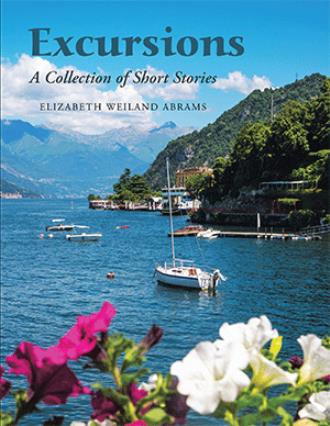
Excursions
A Collection of Short Stories
by
Book Cover & Preview Text
CHAPTER I
The Meet
Djata was the Indonesian goddess of the sea, a 47-foot Nautor Swan sloop sailboat constructed in Pietarsaari, Finland. She was commissioned by Gian Paolo Bini of Florence, Italy, whose wealth was accumulated from family endeavors and currency trading.
Please allow me to digress. As a star student at The American College in London, England, I was to choose between an internship with Hermès in Paris or Emilio Pucci in Florence. I had previously visited both cities, and the European fashion and language I was most interested in was Italian.
At age 21, with five feet eight inches, a 120-pound graceful willowy body and 14 years of ballet training, it turned out that I had the makings of a runway model. I also won second place in a London modeling contest at club Legends. My visit to Hermès in Paris by train from London was a fairytale, graciously greeted by the wellcoiffed Hermès Director, Monsieur de Courcey, who gave me a tour of the Hermès boutique and factory, which was fascinating. I watched them meticulously construct a fine English saddle. Bernard de Courcey was tall, lean, superbly dressed, very handsome and charming.
We strolled the Champs Elysee and ate lunch at a quaint outdoor café. He charmed me with illusions of grandeur working for him at Hermès. We then visited the annex to the Louvre, which was all impressive Impressionism. The large murals of Toulouse Lautrec from the Moulin Rouge specially made an impact on me. I left Paris in a quandary. Later, we would exchange letters. Over the years, I often wondered how my life may have gone differently, had I stayed at Hermès.
I ventured to Florence by train, and remembered the people were simple folk, mostly families traveling from one town to another with their brood and food, mostly panini.
In Florence, I taxied to where I was to live for the next three months, in a small stark dingy stucco second floor apartment on Via del Purgatorio, adjacent to Via dell’ Inferno. Yes, purgatory and hell. There were three of us, each of whom had earned a different semester study program. April, Nancy and I were to share this tiny sparse three-bedroom apartment with only a cave-like kitchen and rather large, tiled bathroom. My bedroom was a small cell with a cot, pillow, sheet and blanket. There was a small window with a view of the back of the next stucco building. This apartment was rented for us by the Marchese. Truly the only redeeming feature was its location in central Florence.
Strolling around Florence was like walking through the Renaissance with artwork everywhere. Palazzo Pucci was near the Duomo on Via de’ Pucci in the center of Firenze.
April worked in the Pucci Boutique and Nancy in the laboratorio, the design and sewing shop in the palazzo, for their internships. April and I studied Fashion Merchandising while Nancy studied Fashion Design. They were very close, so I was on my own, and young women really did not go out after 6pm alone. During the day, walking to work, I had been goosed a few times.
Since I was a runway and house model, I worked at Palazzo Pucci in a large, gilded room, with high colorful fresco painted ceilings from the Renaissance connected to a large ballroom, with a catwalk, where Malafia and I modeled the collections. In the gilded room were many closets of past collections, a very large mirror in the middle and dozens of pairs of shoes. Malafia was tall and slender and Marchese Pucci’s longtime house model from Ethiopia. She and I became very close but did not socialize. Barbara was a tall middle aged blond short haired German woman, who had skied in the Olympics in her hay day and was now the collection coordinator. I liked her very much; we got on well and I visited her home on occasion. Later we would exchange letters. They both spoke English.
As a house model, I was a live mannequin for Marchese Pucci to create his designs. I arrived early, applied my makeup and spent most of the day in my panties and robe. He would drape fabric over me, or I would try on the first muslin garment for fittings, and then the garment in his chosen fabric, day by day, week by week, garment by garment, each brought by a technician from the laboratorio until the collection was finished. During those times, he and I conversed, and I learned much about him, how he started and grew his business. We traveled to Monte Carlo, Singapore and London for fashion shows. On those trips, I was the collection coordinator, which I took pleasure in and gave me great pride. Also, during the day, Marchese often tasked Malefia and me with coloring the first draft of a new foulard design. I kept a diary that eventually became my internship paper for the semester, which I aced.
Marchese Emilio Pucci was from a centuries-old Florentine family, who had mayor of Florence in his heritage. You were not Florentine unless your family was at least two centuries old. He began designing skiwear, which became popular, then graduated into fashion design, with his popular wildly colorful large prints in the 60s. He used only the finest fabrics of silk, cotton, wool, many of which were made from his foulards. He invented silk jersey. At this point in time, he had boutiques all over the world and buyers came each season to purchase the collection.
Now, I should tell you about Ridgely Ralph Cinquegrana. He was my boyfriend at the time, medium height, handsome chiseled face with crystal clear blue eyes and thick dark hair. Ridgely was intelligent, mild mannered, well-dressed in Italian clothing and footwear and drove a Fiat Spider. Although American, he spoke fluent French and Italian and had lived in a handful of countries. I met him in Atlanta at a pledge party for Kappa Sigma, “Kappa Sig,” where he was an engineering student at Georgia Tech. Ultimately, he would live and work around the world and become a multimillionaire. Ridgely was a passionate lover, and we were in love.
Ridgely’s father, Aurelio, was from Naples, the director of Alitalia on the east coast of the United States and his family lived in Wynnewood, Pennsylvania, a main line suburb of Philadelphia, in a large stone Tudor, where I visited with Ridgely a few times. His mother, Johanna was the ladylike daughter of a three-star general Ralph Ridgely. Aurelio and Johanna had met in Naples when she was an attaché at the embassy. The family had lived and traveled around the world and Ridgely came to visit me in Florence.
I met him at the train station, Firenze Santa Maria Novella, also known as Firenze SMN and we embraced tightly and kissed passionately. Finally regaining our composure, we strolled arm in arm to Via del Purgatorio. Ridgely and I slept tightly cuddled together on that crappy little cot with a sheet, blanket and pillow.
During the day, while I was working, Ridgely ran errands, had a pair of my shoes repaired, revisited sites and old friends. During our lengthy lunches, when Italians ate and had a siesta, we would eat together at an outdoor café.
On the weekend, Ridgely took me to meet the Bini’s, who lived at 43 Via San Bernardino da Siena in a beautiful, large contemporary home up on a hill in a suburb near the statue of David overlooking Siena. I loved that mid-century modern home surrounded by a high fence with an electric gate and flowering foliage. I was in awe.
Formats

Book Details
About the Book
Excursions is a collection of short stories starting with The Adventures of Djata and leads into Two Nightmares, beginning with a very bad dream leading into the true story of rescuing my brother from peril in Cozumel, Mexico.
Djata was a 47-foot Nautor Swan sloop Indonesian goddess of the sea, and this was my journey from dancing in Wisconsin to studying, modeling and sailing in Europe, to crossing the Atlantic Ocean. Along with Djata came Gian Paolo, my intense memorable love story.
I believe I have a very matter of fact straight forward writing style that moves along and will entice you, much like Ernest Hemingway, dare I to say, which is what I strive for, and I hope you will enjoy.
“The best people possess a feeling for beauty, the courage to take risks, the discipline to tell the truth, the capacity for sacrifice. Ironically, their virtues make them vulnerable; they are often wounded, sometimes destroyed.” Ernest Hemingway
Ms. Weiland Abrams also wrote, and published Life is a Smorgasbord, a racy compilation of the trials, tribulations, trepidation, and soul-searching through separation, divorce, single motherhood, the quest for true love and reflection on life and the world around us.
About the Author
Elizabeth Weiland Abrams graduated from the American College in London, United Kingdom, Magna Cum Laude with a Bachelor of Arts Degree. She has had 14 years dance training, speaks Italian, sailed the trans-Atlantic, enjoys the outdoors, traveling, and most of all being a mother. She now resides in Jenkintown, Pennsylvania.