
'Elliniki Istoria' "Greek History"
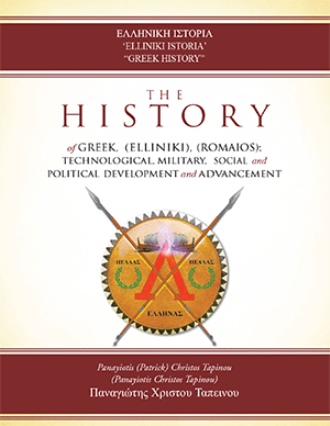
The History of Greek, (Elliniki), (Romaios); Technological, Military, Social and Political Development and Advancement
by
Book Cover & Preview Text
THROUGHOUT PRE-MODERN HISTORY, THE GREEKS WERE ONE OF THE MOST ADVANCED CIVILISATION IN THE WORLD SPEAKING IN TERMS OF TECHNOLOGY, MILITARY, SOCIETY, LAW, POLITICS, MEDICINE AND OVERALL ACADEMIC AND INTELLECTUAL DISCIPLINES. This goes from as far back as the Greek Bronze Age in 1600 BCE when the Pentekonter was thought to have been invented by the Mycenaean Greeks, or even in circa 700 BCE when the Greeks of the city of Corinth first invented the Trieres (Trireme), until around 146 BCE by which time most of the city-states or states of the Greek world had been absorbed and incorporated into the Roman Empire through either alliances, conquests or becoming protectorates. This was the case with the Greeks again during Byzantine times from circa CE 610 until (if thinking conservatively) CE1025 at the height of Byzantine power at the death of ‘Vasilios Vasili II Vulgaroktanos’ (Emperor Basil 2nd "Bulgar-slayer"), and quite reasonably until CE 1204, when the 4th Crusade resulted in the sacking of Constantinople, or even possibly until CE 1453 when the empire finally fell. This work will explore the complexity and development of Ancient and Medieval Greek civilization in their heydays, with a focus on Greek military, political, and territorial development. BY CIRCA 1600 BCE, THE PROTO GREEKS HAD DEVELOPED INTO A CIVILISATION THAT WE REFER TO AS THE MYCENAEAN CIVILISATION OR MYCENAEAN CULTURE. This was named after one of the earliest discovered Mycenaean sites at Mycenae which was also a major settlement of this civilisation. They had perfected all the previously mentioned skills and were spread out amongst hundreds of cities and towns that would have been considered major settlements for their time. These settlements ranged from semi- autonomous or fully independent kingdom city-states to powerful kingdom-states that controlled several other cities and their surrounding countryside. They were composed of a warrior aristocratic class that was led by a King, all of whom, both king and warriors, ruled over non warrior citizens who specialised in other areas and jobs or professions that were essential to the running of their society, such as pottery makers, farmers, black smiths, merchants, jewellery makers and various others, all of whom had also the previously mentioned early Helladic Era skills. The King and warriors also kept slaves. The King and his essential people or his entourage, and his warriors, and all non-warrior citizens who they required to keep them running, lived in a fortified citadel that was usually located on an easy to defend hill. The rest of the non -warrior citizens lived in the settlement around the citadel that was usually not defended by another set of walls, or lived in the surrounding farmland in the case of the farmers and their families. However, rich or more well off cities had walls protecting the entire settlement, as well as a citadel for the king and aristocracy. The Mycenaean’s were the people who conquered the Minoans on Crete, bringing an end to that civilisation and subsequently adding that island to the lands they populated. This cultural and civilisation era of the Bronze Age that is being discussed, starting from 1600 BCE and lasting until circa 1100 BCE, is called the Late Helladic period when regarding the Greek World. THE FOLLOWING PERIOD WAS THE CLASSICAL AGE OF GREECE, WHICH BEGAN IN CIRCA 479 BCE AFTER THE CONCLUSION OF THE FAILED PERSIAN CONQUEST OF GREECE DURING THE SECOND PERSIAN INVASION OF GREECE. The Greeks had repelled this successfully, winning such major battles as the large naval Battle of Salamis and the large land Battle of Plataea in which the Persians lost many times more men and ships than the Greeks. The Greeks also had such memorable losses as at Thermopylae and and the accompanying naval Battle of Artemisia in which their fleet destroyed up to twice as many Persian ships as the Greeks lost and the Spartan led Greek land force killed as many as 20,000 Persians for the loss of 300 Spartans, a Spartan King and around three thousand other Greeks. The Classical Age of Greece included the Athenian Golden Age which saw Athens become a maritime Mediterranean superpower which embraced democracy and flourished as a great civilisation. Athens accomplished this by creating the Delian League in 477 BCE, also known as the Athenian League or League of Athens, which was an alliance led by Athens herself. It was created for the purpose of further continuing the war with the Persians after the Spartans and the Peloponnesian League members had decided to end their involvement in the loose alliance of Greek States that had been fighting Persia. This withdrawal of the Spartans and their Peloponnesian League allies occurred after the Greek Alliance had liberated the Greek city of Byzantion in Eastern Thrace by which time it had also liberated the Greek city-states of Asia Minor from the Persians, which the Spartans and their allies saw as the goal of the original alliance and therefore believed it was no longer necessary to continue the war with Persia. However, the Delian League eventually turned into an empire that Athens itself basically controlled. At the end of the second phase of the Greek-Persian War, Athens had, with the help of the Greek Allies, liberated the Greek states of Western Asia Minor from Persian subjugation and they joined the Greek Alliance. These Greek city-states had been under Persian rule since circa 540 BCE when Persia conquered them. They had attempted to rebel against the Persians in 499 BCE and this rebellion lasted until 493 BCE when many of these cities were finally crushed by the Persians, leading to a peace treaty. Many thousands of soldiers were lost on both sides as both had achieved major victories against the other, but the Ionian Greeks lost many cities full of people and could not sustain such losses. However, the peace treaty was generally seen as just and fair for the many Ionian city-states that survived destruction. Because Athens and Eritrea had supported the Ionians by sending them troops to help fight the Persians, Persia decided to punish them by attempting to conquer them, and in the process hoping to add the rest of Greece to the Persian Empire. This is what led to the Greek-Persian War and the failed Persian invasion of Greece that was previously mentioned.
Formats

Book Details
About the Book
The book Elliniki Istoria, is a book about all of pre-modern Greek history, with a focus on Greek warfare and the political development of the Greek world, from it's beginnings in the Ancient era until the dawn of the early modern era. So, this book covers the Ancient Greeks from the proto-Greek culture, through to the Greek Bronze Age, Greek Dark Ages, Archaic Greek period, the Classical Age of the Greek World, the Hellenistic Age of the Greeks, and then to the Medieval Greek era of the Byzantine Greeks. The book will seek to enlighten readers on Greek military history and Greek warfare, while showing the sophistication of pre-modern Greek civilization.
About the Author
Author Patrick (Panayiotis) Christos Tapinou is a student of Ancient, Medieval, and Modern History, studying at the University of Queensland in Brisbane City, in the South-East corner of the State of Queensland in Australia. He is currently working his way through a Bachelor of Arts, with a single combined major in Ancient History and History, with a minor and electives in other areas. He was born in the Brisbane City area in 1990, and has lived in Brisbane for all of his life, with travels to Cyprus and Greece to see some of the historical sites, and to see relatives who live there. Patrick has had a keen interest in history and military history from a young age. He is of Greek Cypriot ethnic descent, and of Greek Orthodox Christian faith, though a moderate Christian, choosing not to subscribe to fundamentalist Christianity. Being of Greek Cypriot descent means that Patrick has a passion for Greek history, and this, combined with his studies in Ancient, Medieval and Modern History (including the study of Greek history in these three eras) at a relatively well ranked university, makes him a good writer of a book about Greek history.