
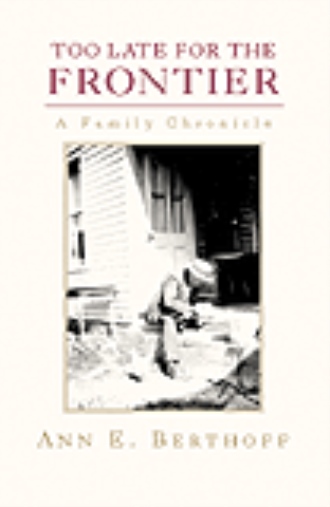
TOO LATE FOR THE FRONTIER
A Family Chronicle
by
Book Cover & Preview Text
Formats

Book Details
About the Book
Born before the Civil War, my grandfather was all set to leave
Dubuque County, Iowa for homesteading in Nebraska when he
discovered that the U.S. Land Office had closed. No more cheap
land; he was too late for the frontier. He spent the rest of his life
trying to live like a pioneer, making everybody else miserable
in the process.
His story is told here in letters written to me by his son
(my uncle) in answer to my query: “What was it like, growing
up in a prairie village at the turn of the century?” I have
supplemented Benton Rees Anderson’s letters with my
remembrances, along with those of other members of the
family, and have provided a matrix for the family history that
Benton was fond of laying out in his wittily sardonic prose.
Franklin Pierce Anderson (1856-1932) was surely an
eccentric character, but I see him as nonetheless representative of
an American type, the independent man whose attempts at
self-sufficiency foster anti-social attitudes.
“Ann Berthoff writes forcefully and idiomatically, with insight
and humor. Her book will interest those readers curious about the
complexities of American culture, the evolution of life in
the “Middle Border.” Many readers will find Franklin Pierce
Anderson—and some of his relatives—unforgettable! I found my
own parents on nearly every page.”
--Robert D. Cross, University of Virginia
About the Author
Born before the Civil War, my grandfather was all set to leave Dubuque County, Iowa for homesteading in Nebraska when he discovered that the U.S. Land Office had closed. No more cheap land; he was too late for the frontier. He spent the rest of his life trying to live like a pioneer, making everybody else miserable in the process. His story is told here in letters written to me by his son (my uncle) in answer to my query: “What was it like, growing up in a prairie village at the turn of the century?” I have supplemented Benton Rees Anderson’s letters with my remembrances, along with those of other members of the family, and have provided a matrix for the family history that Benton was fond of laying out in his wittily sardonic prose. Franklin Pierce Anderson (1856-1932) was surely an eccentric character, but I see him as nonetheless representative of an American type, the independent man whose attempts at self-sufficiency foster anti-social attitudes. “Ann Berthoff writes forcefully and idiomatically, with insight and humor. Her book will interest those readers curious about the complexities of American culture, the evolution of life in the “Middle Border.” Many readers will find Franklin Pierce Anderson—and some of his relatives—unforgettable! I found my own parents on nearly every page.” --Robert D. Cross, University of Virginia