
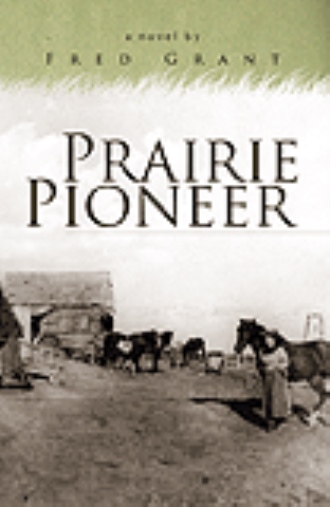
Prairie Pioneer
by
Book Cover & Preview Text
Formats

Book Details
About the Book
Prairie Pioneer is the story of Adam Martin, his wife, Danielle, and their four children who journey by wagon train from their farm in Larue County, Kentucky to Oklahoma. The lure of free land enticed the Martins to undertake the nine-hundred mile journey. In the year 1870, Adam met his wife-to-be, Danielle Fontaine, in Natchez, Mississippi. When the riverboat he was working on, the LaBelle docked to load hardwood to fuel its boilers, Adam had a day free of duty. A farm boy, he took the opportunity to explore the countryside. Strolling along a country lane, he met the girl who was to become his wife. His courtship was complicated by a two weeks time limitation and the reluctance of the girl to leave her close-knit family. Overcoming odds, Adam was successful in his courtship. Married, the couple traveled on the LaBelle to Kentucky where they purchased and lived on a tobacco farm. Four offspring were born in the initial ten years of the marriage„othree boys and a girl. The United States government opened the Cheyenne-Arapaho Strip in western Oklahoma to settlement in 1892. Adam¡¦s friend, Will Kelly, invited Adam and his family to join him and others in making the trek to participate in the scramble for free land. Adam calculated the trip by wagon would require two and a half months. To reach the site by the date of the scramble, the wagons would be required to leave no later than February 1, 1982. After two months of intense preparations, which included the purchase, of an additional wagon and team, the Martins joined four other families in the journey west. The ardors of living our-of-doors in the cold, with occasional rain or snowfall twenty-four hours each day, was far more debilitating than anticipated. Especially for women and children. Adding to the travelers¡¦ woes, frequent emergencies created delays, which created losses to the time schedule. When it became apparent the wagons would not reach western Oklahoma by the date set for the scramble, Adam and his two friends, Will Kelly and Otis Eskew, decided to ride on horseback ahead of the wagons. The Kentuckians arrived in western Oklahoma at the site of the land opening in time to participate in the scramble. The three friends were successful in claiming farms of their choice but not until they overcame a challenge by Sooners who slipped in ahead of the starting signal. Once they were on the barren prairie with their families, the pioneers were confronted with several urgent concerns. Foremost was the need for housing. Fences were essential to prevent cattlemen from grazing their herds across fields and pastures. An adequate water supply was an absolute necessity for household uses and livestock . Another immediately requirement was the planting of crops within a short time after arrival. Roads, churches, and schools were non-existent Cooperation between homesteaders was vital if the necessities for survival on the frontier were to be addressed. Adam Martin became a leader in developing and implementing strategies to achieve those objectives. Cattlemen who had grazed their herds on prairie grasses unimpeded for years bitterly opposed the establishment of farms with barbed-wire fences. A range war between cattlemen and farmers began with the installation of the first fences. Adam became the chairman of the Herd Law Committee which made him a target of the cattlemen. Cheyenne Indians lived in an encampment a few miles from the Martin farm. The family became acquainted with the Chief of the tribe and his family. A son, Luke, became friends with the Chief¡¦s daughter, Bluebird, which created an interesting situation for both families. Luke¡¦s wooing of Bluebird was not the only romance in the family. Each of the offspring had unique courtships leading to marriage. The Martins discovered farming on the prairie to be more uncertain than they had experienced in Kentucky. Severe weather conditions resulted in crop failures. Lack of rainfall during the growing season w
About the Author
Fred Grant was born in 1920 on a dry weather farm seven miles west of the fictional Martin homestead that is the focal point of Prairie Pioneer. His father and mother both came with parents as youngsters to Oklahoma Territory in covered wagons when the Cheyenne-Arapaho Strip was opened for settlement. He remembers sitting for hours listening to his father and uncles talk of pioneer days. That is how he gained much of the knowledge to write Prairie Pioneer. When the Japanese bombed Pearl Harbor, Grant enlisted in the Army Air Corp. During the war he courted and married a girl from Kentucky. Upon receiving his discharge in October 1945, he returned to the University of Oklahoma earning a degree in Civil Engineering. After graduation, he worked on the design and construction of civil projects in the Midwest for eighteen years. He finished his career in Philadelphia with the Water Pollution Control Program of the Environmental Protection Agency. Now retired, Prairie Pioneer is his third publication. He and Betty, his wife of sixty-four years, live in Cherry Hill, New Jersey