
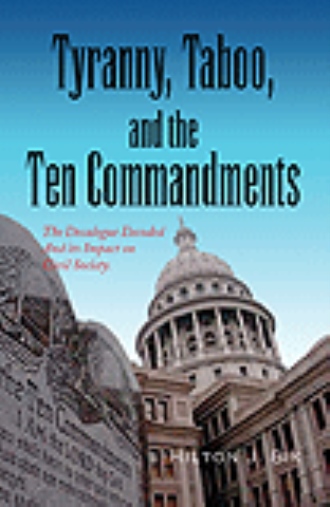
Tyranny, Taboo, and the Ten Commandments
The Decalogue Decoded And its Impact on Civil Society.
by
Book Cover & Preview Text
Formats

Book Details
About the Book
The Hebrew Bible is arguably the most influential work of all time—the most prized, and most studied, literary possession of Western civilization. Yet its message remains enigmatic, obscured by the cryptic nature of its archaic vocabulary.
Using the “Ten Commandments” as an illustrative portal, Hilton Bik explains how the West fundamentally misunderstands the Holy Word emanating from the East. Drawing upon an illustrious array of contemporary
scholarship he demonstrates how traditional biblical
commentary is chronically jeopardized by entrenched
presuppositions that preclude an accurate interpretation of
the exotic narrative.
This unbiased, historically based analysis of the ancient
manuscript yields some startling discoveries—insights
that test the very foundational ideas of both Judaism
and Christianity and question the commonly accepted
nexus between the Decalogue and civil society.
About the Author
Sometimes known as the “sheep farmer–philosopher,” Hilton Bik began his life’s journey in the British colony of Rhodesia. He grew up spontaneously straddling three very different, perhaps even irreconcilable, worlds—a traditional Jewish home, nestled in a British Imperial enclave, set within the larger context of indigenous tribal culture. This experience would forever shape his attitudes and his thinking. Refusing to take up arms against the tide of African political liberation that surfaced in the 1960s, he escaped to South Africa and, after graduating in philosophy, comparative religion, and economics at the University of Cape Town, fled to Israel. Bolstered by a youthful bravado and a natural curiosity he indulged in the “kibbutz” social experiment, savored the “yeshiva” (Rabbinical Seminary) intellectual environment, and flavored a taste of the frontier by herding cattle on the Golan Heights—all the while grappling with the issues of self-definition and group identity, ethnic denomination, and nationalist ideology, that arise in a modern pluralistic world. Arriving on the shores of America in the late 1970s as a stateless refugee, he embarked upon his own American dream, establishing a sheep ranch in rural Georgia, where he resides to this day. Since retiring from active farming he has devoted his time to further study, writing, and the founding of an economic empowerment project in Zimbabwe.