
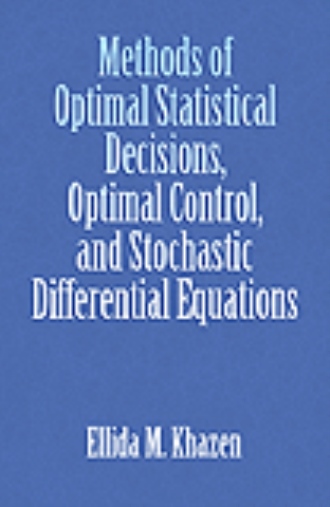
Methods of Optimal Statistical Decisions, Optimal Control, and Stochastic Differential Equations
by
Book Cover & Preview Text
Formats

Book Details
About the Book
This book provides the reader with some insight into the mathematical models of random processes with continuous time, stochastic differential equations and stochastic integrals. An advanced development of the mathematical methods of optimal statistical decisions, statistical sequential analysis, and informational estimation of risks, and new methods and solutions to the important problems of the theory of optimal control are presented. The new original results obtained by this author and published shortly in her numerous scientific-research papers are presented in a systematic way in this book. The book is intended for engineers, students, post-graduate students, and scientist researchers. The presentation of the material is accessible to engineers.
About the Author
Ellida M. Khazen was born in November 1937, in Odessa, Ukraine, USSR. In 1955 -1959 she was a student of Department of Mathematics of Moscow State University after M.V. Lomonosov (Moscow, Russia, USSR) and graduated with Honor ('Red') Diploma (Master Degree) in 1959. She received her Ph.D. degree in Mathematics from Department of Mathematics of Moscow State University after M.V. Lomonosov in 1962. She received her Doctor degree in Applied Mathematics awarded by Russian Supreme Testimonial Committee in 1994. She was working as Senior Scientist Researcher Mathematician at Moscow Scientific-Research Institute of Device Automation in 1962 -1996, and also as Visiting Lecturer at Department of Mathematics of Moscow State University, and as Visiting Lecturer at Moscow Institute of Radio Engineering, Electronics and Automation (MIREA). She has published two scientific monographs (in Russian) and more than 50 scientific-research papers (in Journals of Russian Academy of Science, in Russian and in English, and in International scientific journals, in English) in the areas of the theory of turbulence onset, the theory of random processes, filtering and signal detection, optimal statistical decisions and statistical sequential analysis, informational estimation of risks, and the theory of optimal control.