

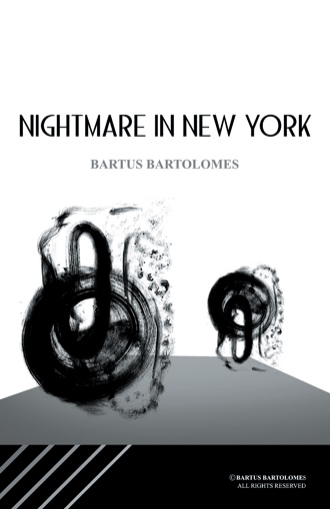
Nightmare in New York
by
Book Cover & Preview Text
Formats

Book Details
About the Book
When commonly referring to overloaded information, to obsessive accumulation of signals in the circuit of production and reception of the visual and textual context, we are generally content with a kind of observation, a confirmation which actually leaves everyone overwhelmed by this sequence nearly uninterrupted in its unfolding and repetition. Indeed a fact by now acquired, but in front of which it seems to be emerging in the work of Bartus Bartolomes, as for natural antidote, a spread of verbal-visual gasps, pictograms on the boundary of the text, which hybridizing in its occurrence builds a language inspired by a visualism not mechanically decodable. The artist's iconic message, shaped through disarticulations in ordinariness and predictability of the media message, both technological and not, free a linguistic joyride which does not deny the ritual of the standardized information, but puts it in a condition where it loses its reference code, then it loses its fair pervasiveness and translates it into the actual encounter with the own circuit of the recipient of that message, a receptive humanity that shows itself in its variant both as western alphabetized audiences, and as peripheral ethnic group to linguistic mechanisms typical of post-technological world… The ludic soul permeating the iconic artist's writing sweeps like a breath his overcrowded montages, gives them exotic fantasies, transforms the human desires in deformed spatial compartments waiting to trace a spontaneous and direct expression of the self. The color and design coagulate around this sort of writing that, starting from the previous visual poetry, wants to return to a visual word that hybridizing realize itself beyond a precise control, beyond a ' search ' resulting from the intention that produced it, but a word mark that hovers without reflecting in a semiotic unique referent, so that the language may finally lead us back to what precedes and nourishes it.
About the Author
Bartus Bartolomes was born in Venezuela. Upon finishing his secondary education, he traveled to Europe and settled in Paris. In the late seventies and early eighties he was involved in several events, carried out in Italy and other European countries, organized by the group “Zeta International”, promoters of “New Visuality” or “Visive Poetry”, together with Carlo Marcello Conti, Lamberto Pignotto, Adriano Spatola, Gerard Jaschke, Eugenio Miccini, Luciana Arbizzani, T. Blittersdorf, Graziella Borghesi, Erio Sughi, among many others. In the mid-eighties, he lived in India and China, where he participated in various cultural events. In New Delhi, the “Dhoomi Mall Gallery”, shown his work to interact and form liaisons with the exponents of the vanguard neo-symbolist and neo-tantric movements of that country. Among them are names that are now reference of contemporary art from India, such as Swaminathan, Satish Gujurat, Santosh, Francis Souza, Paramith Singh etc. During this period he began his experimentations in “object-painting”, adding sequins and textile to his artistic research. Subsequently, he studied calligraphy in Beijing, China and 'Bantu' art, in Libreville, Gabon. Africa. In the early nineties he returned to his country where he attempted to develop some graphic and art projects along with some other writers. The group disbanded prematurely because of dissimilar and divergent political and cultural concepts. Bartus returned to Europe in the mid nineties and started his project on “Global Rights” to water, in an effort to motivate the 'International Community” to create large 'Caves of Drinking Water' to assuage the droughts of 65 countries which were suffering from seasonal shortage of fresh water. He currently alternates living in Rio, Paris, New York and Caracas dedicated to painting, sculpture, video, mix media and writing, compiling and editing his books and promoting several aesthetic manifestations, like: “Khromatone” ; “B2art” ‘Dancing Trees’ ‘Nest-Gen’.