
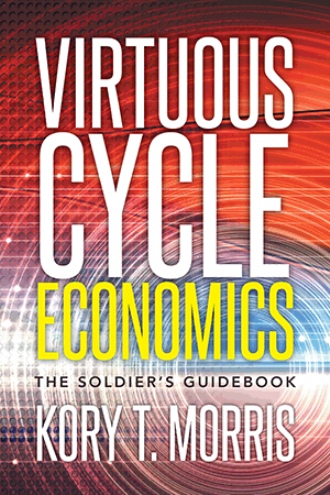
Virtuous Cycle Economics
The Soldier’s Guidebook
by
Book Cover & Preview Text
Formats

Book Details
About the Book
This book is intended to be an easily read and understood guideline that is intended on giving the reader a brief overview of our economy. This covers past and present situations, occurrences, and fundamentals of our capitalistic society and is intended to reveal flaws, fixes, and methods of coping with the status quo. The book also contains a breakdown of how the current credit system became what it is today, its benefits, its shortcomings, and how to cope and begin to take advantage of strategies that can be beneficial to the middle-class citizen. It also covers the importance of having good credit and why the credit bureaus have little to no incentive to keep an accurate record of your FICO score. It also explains how we are viewed in the eyes of our creditors in terms of our risk tolerance levels and steps that can be taken to correct and monitor your credit score with no out of pocket cost to the consumer. Also included are tips on how to live above the means of one’s salary through the year by averaging one’s tax returns over a period of time prescribed in the book. This is intended to allow the reader to accurately predict a rate of tax return (assuming the conditions are as set forth in the book) and allow for a monthly additional budget utilizing a credit card. This utilization of the card will account for the interest that will be accrued and first subtracted from the tax return amount. That amount will then be divided by twelve to give the resulting sum of the monthly additional spending allowed above one’s monthly salary. An attempt has also been made to explain the interconnectivity of one’s security clearance and perceived level of risk when an individual is carrying a large amount of debt. It illustrates how one’s security clearance may be taken away due to issues with debt and provides advice on steps that may be taken to stop or delay this process through bankruptcy. The book explains what to expect after filing bankruptcy and gives a strategy or method of what to do while going through the process and emerging more financially stable. A plan of action for constructing a functional budget is explained and illustrated, and a guide for investing the newly available capital is outlined for the beginner-level investor. An attempt to close the cycle is done by explaining what to do with newfound wealth if you are successful in your endeavors in the form of wealth management and tax advice.
About the Author
I was born in St. Thomas, Jamaica, in the Princess Margaret Hospital on the thirteenth day of November 1981 (it was a Friday). My father was a chef working for the United States Navy in Guantanamo Bay (Cuba), and my mother was an early-education schoolteacher. I was taught to read at an early age by my mother, and I read books such as Emil and the Detectives, The Young Warriors, The Cloud with the Silver Lining, and Oliver Twist. My early childhood and middle school education took place in Jamaica; but at the age of fourteen, in 1998, we migrated to the United States of America. I had always dreamed of coming to America, and it somehow felt more like home to me than anywhere else I had ever been. I had always heard the term land of opportunity and believed in this ideal wholeheartedly. I and my older brother Greg excelled at academics while attending North East High School in Saint Petersburg, Florida. However, shortly after my fifteenth birthday, I obtained a job working at the local Winn-Dixie as a stocker, and my grades began to suffer a bit. This was my first job, and it lasted only for a few months. This was as a result of accidentally being thrown from a ladder when the store manager bumped into it while I was still at the top attempting to retrieve items to restock the store shelves. I injured my shoulder, and my mother decided it was best for me to terminate my employment with Winn-Dixie. Shortly after leaving Winn-Dixie, I went to work for the Publix grocery chain bagging groceries. At this time in my life, I was in love with the sport of soccer, and my brother and I decided to try out for the North East High School soccer team (the Vikings). We were unsuccessful in our attempt to make the team, and it was a difficult reality to accept. My brother then decided to focus exclusively on his academics and gave up the dream of playing soccer. However, it was extremely difficult for me to accept this failure. Hence, after soccer tryouts, I immediately went home and started practicing in order to ensure that I would make the team the following year. I practiced every day from the day I got told I wasn’t good enough to make the team until the next year when I again attended the team tryouts. I practiced without regard for weather, time of day, or physical pain. I had to make the team—and make the team I did. I was voted one of the three team captains on the North East High School soccer team in 1999. It was one of the proudest moments of my entire life. It was extremely gratifying due to the hard work that I had put in to ensuring that I gave myself the best chance I could to be selected as a member of the squad. Later that year, the path of my life was altered when an army sergeant (recruiter) visited our home in order to convince my brother to sign up for military service. As we were sitting at the table listening to the recruiter, it was I who became more interested in joining the service. My mother was completely against this decision; and since I was only seventeen years old at the time, I could not sign up without my parents’ consent (as I was not yet eighteen years of age) and would require a signed waiver. I was determined to join the service and therefore asked my father to sign the document. He consulted with my mother and convinced her to sign the document since I felt so strongly about it. I was only 150 pounds soaking wet, and my father saw me as feeble and sickly as in my earlier years I frequently visited the doctor for common afflictions such as a cold and various allergies. His decision was based on the fact that he thought I would attend the army’s boot camp training and fail to meet the standards. I would then return home realizing my mistake and continue on the path they had envisioned for me. He could not have been more wrong. I applied myself with the same determination that I had with my soccer regimen; and despite starting in the bottom 10% of the physically fit candidates when we began the training, I emerged in the end as top of my graduating class. I received an Army Achievement Medal for physical fitness and was promoted to the next higher rank of PV2 at my graduation ceremony. I was one of three soldiers of a class of three hundred selected to represent the graduating class at the front of the formation, and I accepted my bestowed honor with the utmost pride. Upon graduating the basic training course, I was sent to complete my military occupational specialty (MOS) training as a power-generator technician for a period of five months in Aberdeen (Maryland). After successfully completing the training, I was then sent overseas to my first duty station in Hanau, Germany. I then saw my first deployment to Kosovo within my first few months at my new base camp. It was here that I met an army captain; and again, it would alter the course of my life. He was a Green Beret (Special Forces soldier), and he carried himself in such a way that he stood out from the rest of us. I was so impressed by his demeanor and professionalism that I felt compelled to talk to him even though I was only a private. (This is the equivalent of a factory assembly-line worker walking up to the CEO and asking him how he did it.) The captain spoke to me as if I were an equal and answered all my questions. It was then that I decided that one day I wanted to be like him; I wanted to be a Green Beret. Shortly after leaving Kosovo, I deployed to Poland for the Joint Visitors Bureau (JVB) where I was one of the few soldiers selected as a part of a detail (a group of tasked soldiers) to drive for General Wallace, General Myers, and General Shinseki. Shortly after the (JVB) deployment, the September 11 events occurred, and I found myself in Iraq soon thereafter. Upon completing my Iraq tour, my four-year contract had ended and my first child was on its way. I then decided it was time to use the Montgomery GI Bill to attend school in order to obtain a college degree. While attending college in Saint Petersburg, I chose to pursue a degree in criminal justice as I intended on becoming a police officer. However, after receiving three speeding tickets within a two-year period while in the program, I was not permitted to advance to the schoolhouse (residency) phase of the police academy. As a result, I reentered active military service in March of 2006 and signed a contract to train as an aviation electrician (MOS 15F). While serving as an aviation electrician in Fort Riley (Kansas), I had a chance encounter with a Special Forces recruiter and decided that it was time to pursue my dream job. I then attended the Special Forces Assessment and Selection course in Fort Bragg (North Carolina) and successfully completed the training. I was selected to attend the second phase of the course as a satellite communications sergeant (MOS 18E). I successfully completed the training in 2009 and joined the Special Forces Regiment. It was one of the proudest moments of my life, and one of my greatest achievements that my family can be proud of for generations to come. Currently, I am in my fourteenth year of service, and I can now proudly add author and inventor to my list of accomplishments. I am married to my wife of seven years, Heather, and I have three beautiful children: Jalen, Jenai, and Justin. I have recently made the distinction between the man I really am and the man that God intended me to be. I have recently made changes in my life in order to move closer to God, and I thank you for purchasing my book and for visiting this website. May God bless you, and may God bless America, the greatest nation on earth.