

Judaism Is Right
by
Book Cover & Preview Text
Formats

Book Details
About the Book
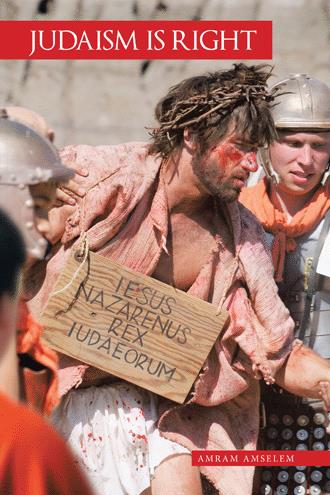
Scientists claim to have found the Tomb of Jesus and that he is buried next to his son. A famous archaeologist says that after 150 chemical tests he could support his theory that Jesus was married and had offspring. A leading Israeli archaeologist and a Canadian documentalist presented the results after 35 years of investigation, claiming that they found the sepulcher of Jesus of Jerusalem, and that he would be buried next to his supposed wife and son. The journalist and documentary maker Simha Jacobovici announced that the archeologist and geologist Arye Shimron determined that the tomb found in 1980 in the Talpiot neighborhood, east of Jerusalem, really belonged to the family of Jesus, reported the Jerusalem Post site. Shimron and his team performed more than 150 chemical tests to determine the antiquity of the tomb, where in addition to Jesus would be buried “Judah, son of Jesus”, and his wife, 20 percent of the ossuaries have inscriptions, and most of those found in the Barrio de Talpiot square with the information about the History of Jesus regarding the antiquity and the names, such as María, José and Judah. Although the names were very common in the time of Christ, it is assumed that few families would have a tomb where the kinship is read, for example, between Jesus, Mary and Joseph. Shimron and his team managed to access the so-called Osario de Santiago, found in 2002, where one can read that it belongs to Santiago, son of José, brother of Jesus. The archaeologist noted that the chemicals in the stone are identical to those found in the Talpiot tomb. The chemical composition of the stone of the Ossuary of Santiago and the earth in its interior were identical to the samples obtained from the supposed tomb of the family of Jesus found in Talpiot. “This discovery proves that the ossuary is authentic and that the tomb really belongs to the family of Jesus of Nazareth,” said Jacobovici.
About the Author
Amram Rabbi Amselem is a religious and Jewish community leader in Miami. He was born in the city of Tangiers, Morocco in 1942. He is a descendant of Jews from Spain. His maternal great-grandfather, Rabbi Rafael Eljarrat, born in Morocco was the chief Rabbi of the city, Larache in Morocco. At the age of 16 Amram traveled to London and began his studies in Judaism at the Yeshivat Tiferet Israel in Sanderland north of England, under the direction of leader Shmuel Chayim; one of the greatest Rabbis of the time. Later on, he returned to his hometown and began to teach the Rabbinical Seminary. In 1967 he was invited by the Venezuelan Israeli Association, to exercise the role of Rabbi alongside spiritual leader Moses Binia z.l. Shortly after, he assumed the leadership of the community. Amram co-founded the Institute for Adult Education of the Council of Venezuelan Rabbis and the Committee of Representatives from Churches and Synagogues, established in Venezuela, CRISEV. His work led to receiving the award, the Order of Francisco de Miranda, by the then President of Venezuela, Carlos Andres Perez Q.e.P.D. This distinction is intended to recognize outstanding merit, services that contributed to science and the progress of the country. Years later the community awarded him with a scholarship that allowed him to travel to Israel in order to graduate as judge in the area of divorce, from the renowned institution Yeshivat Porat Yosef based in Jerusalem. Amram received his diploma from one of the leading figures in this field, the President of the Rabbinical Court of Tel Aviv Gaon Refael Abbo z.l. and he was ratified by two of the leading Rabbis of Israel, Rabbi Mordechai Eliyahu z.l. and the great Rabbi Ovadia Yosef z.l. In 1980 he assumed the direction of the Sephardic Congregation of Florida as Chief Rabbi, and inaugurates the headquarters of the Cuban community of Turkish origin. There he creates the Institute for Adult Education. This program benefited an important part of the Miami community. In 1989 he proceeds to create his own congregation and implements various educational programs with the aim of strengthening ties with Judaism. In 2011 he was invited to exercise leadership in Beit Rambam in the area of Sunny Isles Beach in Florida. As part of his integration project he invited different personalities of the Jewish community, including Rabbi and writer Azriel Tauber, Rabbi Eli Mansour and Rebbetzin Esther Jungreis. The same year he was named Rabbi Emeritus of Beit Rambam. Amram became a pioneer in the implementation and monitoring of translations from Hebrew and French into Spanish. His first published work was the Pirke Avot, a treatise on Moral and Ethics Lehman famous rabbi, who happens to live the time of the Reformation in Germany. After years of work and research, he translates and publishes the famous work "The Voice of Torah" written by Rabbi Eli Munk. In addition he published the prayer book "shemoneh Esrei", by Rabbi Abraham Chayim known Feuer. This book was published in English and translated into Spanish. Due to the movement in the United States of "Jews for Jesus" published "My Jewish brothers ... Judaism is right" and also edits a classic of the famous Rabbi Moshe Ben Nachman (Ramban) "The Disputation of Barcelona" work that originated the expulsion of the Jews from Spain in 1492. He has participated in several TV shows in reference to the current situation in Israel before world opinion. Since 2010 it is part of the Ethics Committee of the Jewish Community of Miami. In addition, it acts as judge on divorce and the Rabbinical Court that deals with conversions. He is a member of the Rabbinical Council of America based in New York. Currently he lectures and provides conferences for the general public on topics that bring the Jewish perspective on various issues related to marriage laws, Jewish identity, the crisis in the education of children, family and love, among others. He is also an active delegate of the World Sephardi Union for the United States and Canada, after being approved the law with which the Spanish Government granted the Spanish nationality to descendants Sephardim expelled in 1492.