
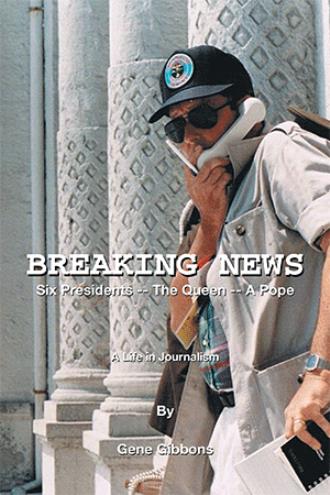
BREAKING NEWS Six Presidents -- The Queen -- A Pope
A Life in Journalism
by
Book Cover & Preview Text
Gonzo journalist Hunter S. Thompson called anyone who covered more than one presidential campaign a “terminal action junkie.” He believed such folks suffer from a deadly addiction. Thompson was right except for the terminal part – while seldom life-threatening, careening from one end of the United States to the other covering a presidential campaign is probably as hard a habit to kick as being hooked on drugs. It’s almost as much of an adrenaline rush as working at what was once considered the pinnacle of American journalism: being a White House correspondent for a major news organization. I got my first taste of riding the political whirlwind that characterizes how Americans choose their leader as a low-level press aide to Democratic presidential nominee Hubert Humphrey in 1968. He lost and I plunged into journalism. Before I retired, I traveled the country reporting on seven more presidential campaigns, defying a burnout rate that sidelined most of my professional colleagues much sooner. I never lost the thrill of the chase in my 40-year career as a reporter. Because of a single-minded dedication to my job that often had serious drawbacks for those closest to me, I got to rub shoulders with six presidents, the Queen of England, even a pope. I’ve been to all 50 states, each more than once, and I’ve visited more than 80 countries. As a matter of idle curiosity I once listed types of aircraft I’ve flown on. I counted more than 40, ranging from a Stearman biplane to an Airbus A-380 jumbo jet, the largest airplane in commercial service. I’ve flown in the backseat of a jet fighter performing aerobatics and experienced a landing and takeoff on an aircraft carrier. I’ve no idea how many miles I’ve flown but a conservative estimate is a million or more. (To the surprise of friends and my chagrin, I accumulated zero frequent flier miles for most of this travel because almost all was on charters or Air Force One.) My proudest career achievement -- being a presidential debate panelist in 1992. Back then, presidential debates weren’t the dime a dozen like they are now: cheap, superficial television programming promoted incessantly by the cable networks. They were few in number, and politically pivotal. The debate that gave me my 15 minutes of fame took place on October 19 1992 at Michigan State University. It pitted Republican President George H.W. Bush against Democratic challenger Bill Clinton and independent candidate Ross Perot. Like my fellow panelists (PBS newsman Jim Lehrer, CNN anchor Susan Rook and UPI White House correspondent Helen Thomas), I believed Bush won the debate. Clinton won the election. So much for our collective expertise as political handicappers. In the beginning, with Humphrey, I crisscrossed the United States time and again for more than eight months. He and Richard Nixon made it a matter of personal pride to visit as many states as possible. That election year was a tumultuous one in our national history. Dr. Martin Luther King Jr. and Robert Kennedy were assassinated within weeks of each other; race riots exploded throughout the country and protests against the Vietnam War grew in intensity. When Washington DC was convulsed with violent demonstrations after King’s slaying, I saw something I never imagined I’d see -- a machine gun nest manned by troops of the 82d Airborne Division on the steps of the U.S. Capitol. I was there when antiwar demonstrators clashed with police at the Democratic National Convention in Chicago. At one point I found myself in the midst of a club-swinging melee outside the Conrad Hilton Hotel, Humphrey’s convention headquarters, as a flying squad of Chicago police attacked a group of people who were merely bystanders. There were yells and screams and a lot of broken plate glass. Like the machine gun nest at the Capitol building it was something I never expected to behold in America. Yet I somehow felt insulated. Strange as it seems to write this today, the bloodshed and destruction that swept the country in my youth seemed remote and unthreatening: I was 26 years old, living a dream. There I was, in the midst of politicians and journalists whom I’d read about or seen on television. Not only that, the pace of campaign travel was absolutely exhilarating! It wasn’t unusual to begin a day in Boston, visit New York, Philadelphia and a town in New Jersey, throw in a stop or two somewhere in the Midwest and wind up late the same day in California. The grueling pace we kept sometimes produced comic results. In one memorable instance, at the end of a very long day exhausted UPI political writer Steve Gerstel stripped to the buff, put his clothes in his suitcase and placed it in the hallway outside his hotel room for pickup. He then took a shower and went to bed. When he awoke the next morning, he realized he’d neglected to unpack any clothes – and his suitcase was gone! Gerstel wrapped himself in a bedspread and made his way to the press bus, reconciled to embarrassment for a while. As the day progressed, colleagues darted from men’s store to men’s store at various campaign stops, looking for appropriate clothing for their naked friend. I think we travelled halfway across the country that day before Gerstel was fully dressed. That all changed over the years – in subsequent elections candidates started confining campaigning to battleground states, foreshadowing the growing polarization of the country. While few people know it, only a handful of states really matter in presidential elections. With the exception of Virginia, the Deep South is reliably Republican, reflecting a conservativism based largely on race and religion. Massachusetts, New York, California and states in the Pacific Northwest are reliably Democratic. The liberalism of these states is generally driven by level of education and income. The nation’s once-Democratic industrial midsection and the U.S. Southwest are where presidential elections are decided. Economic issues generally matter most in so-called Rust Belt states like Pennsylvania, Ohio and Michigan because of dwindling manufacturing jobs. Previously rock-ribbed Republican states like New Mexico and Arizona are now in play because of their growing percentage of college graduates and Hispanic voters. Nowadays presidential candidates rely on television and the social media to reach the voters. By the time I retired, it was not unusual for the candidates to stage one campaign rally a day. They’d spend the rest of the time holed up in a hotel room somewhere, taping interviews via satellite hookups with local TV personalities throughout the region. These “interviews” usually feature softball, even fawning questions. An added bonus for the candidates is that the interviews are often aired as “exclusives” again and again, making it a nifty way to get lots of free television airtime. Studying how running for president evolved during my lifetime would probably be a good way to track U.S. cultural changes and television’s metastasis from near-afterthought to the all-powerful information source it is today. When I first trod the campaign trail, there were no TV cameras on the candidates’ chartered planes – cameras and crews were relegated to what was known as “the zoo plane.” It was called that because of the generally beefy physiques of the individuals who wrestled the television gear from place to place. At the end of the day, a candidate would frequently venture into the press area in the rear of his charter, drink in hand, and banter with the reporters, most of whom the candidate knew by name. These informal sessions were “off the record,” meaning what was said was not for publication. Still, it was a way for journalists to learn about the character and proclivities of the candidate.
Formats

Book Details
About the Book
BREAKING NEWS provides a page-turning look at modern American history through the eyes of a news reporter who covered many of the major developments of our time. The memoir of a longtime Reuters White House Correspondent, this book is loaded with stories about presidents and other U.S. political figures, the Queen of England and a sainted Pope. It also includes the author’s reflections on events and ideas that have shaped his life and the world we live in. Whether you’re someone who can’t get enough of the daily news or an occasional observer of the headlines, you’ll enjoy reading this book – and equally important, you’ll remember it.