
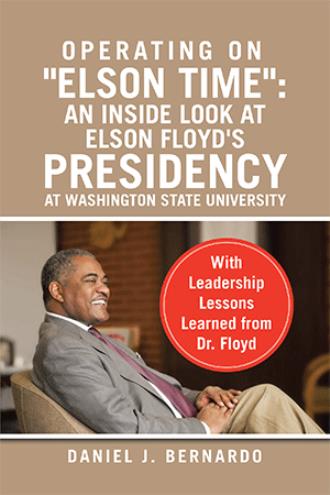
Operating on "Elson Time": An Inside Look at Elson Floyd's Presidency at Washington State University
With Leadership Lessons Learned from Dr. Floyd
by
Book Cover & Preview Text
Most political pundits viewed gaining approval for a second public medical school in Washington State to be impossible; but “most political pundits” had never met a force like Elson Floyd. There were two major political hurdles required to establish a medical school at WSU – authorization and funding. Authorization required changing a 98-year-old law that prevented any Washington public university other than the University of Washington (UW) from having a medical school. This law had stood as an immovable blockade for nearly a century, and the UW was not going to loosen its hold on medical education. However, during this 98-year period, the population of the State of Washington had grown significantly, and medical education being served by a single entity became increasingly intractable. The political battle began in earnest in September 2014 when WSU released a report completed by the national consulting firm MGT of America. The MGT report showed the need for primary care physicians across the state, recommended the educational approach for a new medical school, and concluded that WSU had the capacity to create its own medical school (MGT of America, Inc., 2014). In documenting the need for an additional medical school, MGT concluded that the state wasn’t training enough doctors to satisfy the growing demand for health care, especially in underserved populations and geographic areas. Washington had two medical schools. UW which admitted 120 students from Washington per year and a privately funded osteopathic school, which admitted another 135-145 students per year. In comparison, the 25 most populous states averaged 4.4 allopathic medical schools each. Washington, the 13th most populous state, had only one allopathic school. MGT’s report concluded that the current system did not provide nearly enough capacity to satisfy current or future demand. It estimated Washington would need to train up to 400 additional medical students a year by 2030 just to meet the national average. Equally concerning was the current maldistribution of the state’s active physicians with nearly half of physicians located in King County alone, and 33 of the 39 counties facing an acute shortage of primary care physicians. With all medical students in the Pacific Northwest being funneled through Seattle for degree completion, it should not have been a surprise the lion’s share would end up in the Seattle area. WSU proposed a community-based medical school model. Not only was this the appropriate model to meet the needs of the state, but it was pure political genius. WSU had the capacity to deliver and its locations throughout the state provided a unique platform to assure that the new school’s impact would reach all corners of the state. WSU proposed a format where the first two years of the program would be completed on the Spokane Health Sciences Campus, with third and four year students assigned to one of WSU’s four regional campuses (Tri-Cities, Spokane, Vancouver, and Everett). The third- and fourth-year students would work with clinical faculty located in communities surrounding each of the four campuses. Floyd garnered significant support from key legislators across the state who were convinced that their communities would benefit from this model, as opposed to more of the same from WWAMI and UW. Throughout the fall and winter, President Floyd and his legislative team were playing the ground game, meeting just about every member of the Washington Legislature in their home districts to make their case for the medical school. The team was large and included not only WSU’s lobbyists Colleen Kerr and Chris Mulick, but also Chancellor Brown and a handful of contract lobbyists. Armed with the results from the MGT report, they made the case for the state’s additional investment in medical education. The crux of Floyd’s argument was that this investment was the right thing for the state and for the legislator’s constituency. The latter claim was supported by the community-based model and the notion that not only would the model create graduates to work in the state’s under-served communities, but third- and fourth-year students would also be working in these areas. The process by which President Floyd went about securing approval for the medical school is illustrative of his political genius and unparalleled leadership. If you have watched films about Abraham Lincoln, you know that he went about securing the needed votes for the 13th Amendment (the abolishment of slavery) by making it important to the people who were voting for it. He did not make it about being important to him; rather, he convinced each congressman that voting “yes” was important to them personally and their constituencies. Dr. Floyd employed the same strategy in securing the medical school authorization. Concurrently, representatives of the WSU medical sciences program were meeting with medical providers in every county of the state to explain the community-based model and gain their support. By the beginning of 2015, WSU had gained the endorsement of many of the state’s medical providers, big and small, rural and urban. These endorsements further cemented the political position of local legislators. In March 2015, WSU’s pursuit of an independently accredited medical school passed two major milestones in 36 hours. On the evening of March 9, the Washington House of Representatives voted 81-17 to change the 1917 law limiting the delivery of medical education to the University of Washington. The following morning, the Washington State Senate followed suit with a 45-4 vote. In discussing the votes, President Floyd noted, “What was most heartening about both votes was the passion and deep understanding of the importance of a second state-supported medical school in our state by those legislators who supported it” (Floyd, 2015). On April 1, Governor Jay Inslee signed the bill that amended the 1917 law to allow WSU to open and operate a medical school in Spokane. Inslee was surrounded by WSU medical school supporters during the bill signing, and afterward, the crowd broke into a rendition of the Cougar fight song. The next day, Governor Inslee paid a visit to the WSU Health Sciences Spokane campus to celebrate the bill’s passage. The Spokane community and WSU students from all campuses joined in the celebration. Although Governor Inslee is an UW alumnus, he was a Cougar on that day.
Formats

Book Details
About the Book
In the life of a university, occasionally a leader will be will be encountered with the bold vision and unique leadership qualities to put the institution on a new trajectory of success and reputation. Elson Floyd was one of those leaders at Washington State University. Dr. Floyd’s impact on WSU reaches much further than the tangible elements such as new facilities, programs, and campuses. He changed the culture of WSU from an institution operating in the shadow of its larger, better-funded sister university in Seattle, to one that pursued an aggressive agenda of growth and statewide impact. This work provides an inside look at his leadership style that represented a radical departure from the conservative, risk-averse approach experienced at most institutions across the Nation. He led with an action imperative and routinely broke many of the conventional “rules” professed in higher education literature, resulting in an impressive set of accomplishments over a career cut short by his untimely death due to cancer.