
A K H U
The Venerated Ancestors of Ancient Egypt
by
Book Cover & Preview Text
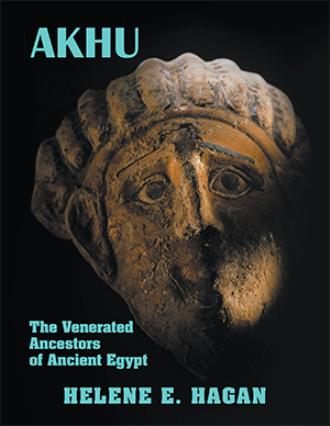
AKHU by Helene E. Hagan , Xlibris , Sept 2022, 130 pages
The prologue to this essay sets the tone for the ensuing study, demonstrating the very certain need to examine the close links between ancient Egyptian civilization and the Berber cultures of North Africa and the Sahara. The introduction indicates the need to begin this investigation with the archaeology of the early days of habitation on the west bank of the Nile, the western region of the Delta, that of the Fayum and of the oases, a northwest territorial area important to the development of all Egyptian civilization.
A first chapter examines the origins of these diverse settlements and their relationship with Libyan and North African groups. This chapter is followed by a study of the beliefs and customs of the Pillar peoples ("Intui") who worshipped their ancestors and had a very great influence on the totality of Egyptian civilization of all times. Ancestor worship as well as several other major aspects of their mythology such as astrolatry relate them to the Imazighen (Berbers) of North Africa.
The Sacred Sovereigns, or First Princes of Egypt, who preceded the first dynasties of kings, were Libyan Chiefs. They commanded the various groups of tribes known collectively as "Rekhyt", and instituted the various cults of primordial deities, most of which had their origins in North Africa, such as the Solar Ram, the great goddess of Sais Neith, the primordial God Amun, the great desert god "Her with the Mighty Arm", the goddess immensely worshipped over the centuries Hat-Hor, the Sacred Cow, and the Warrior Bull God Gurzil of the oases, worshipped by the Berbers of North Africa.
In the chapter on the God Tehuti, Time and the Stars, the creation of calendars according to cosmological data and the entire Egyptian astronomy are attributed to notions whose roots and parallels still existing in some Amazigh beliefs of North Africa are irrefutable. The final chapter of this essay completes the funerary journey through the earthly geography and the stellar universe of a Du-at populated by Resplendent Ancestors, Blessed Beings or "AKHU"
Formats






Book Details
About the Book
AKHU: the Venerated Ancestors of Ancient Egypt is a groundbreaking enquiry which brings together the author’s competence in linguistics, mythology and ethnology as a rich and meaningful investigation of Ancient Egypt. The work includes the support and cultural participation of North African Berber scholars. The book brings out the archaic terminology of earliest hieroglyphic Pyramid texts which the later Greco-Roman vocabulary guiding European scholarship has often masked. Helene Hagan’s background in Mediterranean history and mythology and her knowledge of North African Amazigh (Berber) culture guided her in this remarkable journey. This book seriously contributes to Egyptology and the study of Ancient History.
The prologue sets the tone for the ensuing study, demonstrating the very certain need to examine the close links between ancient Egyptian civilization and the Berber cultures of North Africa and the Sahara. The introduction indicates the need to begin this investigation with the archaeology of the early days of habitation on the west bank of the Nile, the western region of the Delta, that of the Fayum and of the oases, a northwest territorial area important to the development of all Egyptian civilization.
A first chapter examines the origins of these diverse settlements and their relationship with Libyan and North African groups. This chapter is followed by a study of the beliefs and customs of the Pillar peoples ("Intui") who worshipped their ancestors and had a very great influence on the totality of Egyptian civilization of all times. Ancestor worship as well as several other major aspects of their mythology such as astrolatry relate them to the Imazighen (Berbers) of North Africa.
The Sacred Sovereigns, or First Princes of Egypt, who preceded the first dynasties of kings, were Libyan Chiefs. They commanded the various groups of tribes known collectively as "Rekhyt", and instituted the various cults of primordial deities, most of which had their origins in North Africa, such as the Solar Ram, the great goddess of Sais Neith, the primordial God Amun, the great desert god "Her with the Mighty Arm", the goddess immensely worshipped over the centuries Hat-Hor, the Sacred Cow, and the Warrior Bull God Gurzil of the oases, worshipped by the Berbers of North Africa.
In the chapter on the God Tehuti, Time and the Stars, the creation of calendars according to cosmological data and the entire Egyptian astronomy are attributed to notions whose roots and parallels still existing in some Amazigh beliefs of North Africa are irrefutable. The final chapter of this essay completes the funerary journey through the earthly geography and the stellar universe of a Du-at populated by Resplendent Ancestors, Blessed Beings or "AKHU".
About the Author
Born in Rabat, Morocco, her educational path led her from the vibrant streets of Morocco to Bordeaux University, France, where she obtained a License-ès-Lettres in British and American Studies. With two master’s degrees from Stanford University, one in French and Education, and another in Cultural and Psychological Anthropology, Helene embarked on a journey of exploration and advocacy. Her path took her to unexpected places, including the Pine Ridge Indian Reservation, where she conducted fieldwork among the Oglala Lakota people, and later directed a photo identification project funded by the South Dakota Committee on the Humanities for the Oglala Lakota College. She also holds a lifetime position as Associate Curator of Paul Radin’s anthropological archival collection at Marquette University.
In 1993, Helene founded the Tazzla Institute for Cultural Diversity, a non-profit educational organization dedicated to safeguarding, supporting, and disseminating Amazigh cultural heritage in the United States and abroad. Under her leadership, the institute became a beacon of cultural exchange and understanding, organizing numerous initiatives to promote Amazigh culture globally.
Helene’s impact extended beyond academia and advocacy; she also made significant contributions to the world of media and arts. As the founder of Amazigh Video Productions, she produced 55 educational and cultural television programs, shedding light on the richness of Amazigh heritage and traditions. In 2008, she pioneered the Los Angeles Amazigh Film Festival, the first of its kind in the United States, offering annual presentations of Amazigh documentaries, films, art, and music for two decades.
She has published nine books, available worldwide through amazon bookstores.