
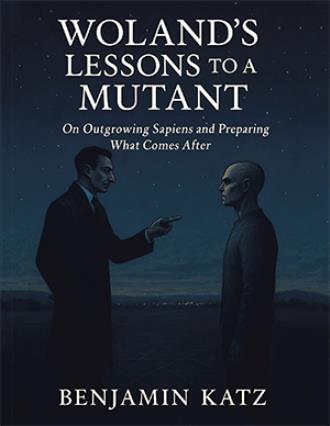
Woland’s Lessons to a Mutant
On Outgrowing Sapiens and Preparing What Comes After
by
Book Cover & Preview Text
Formats











Book Details
About the Book
This is not a book of comfort.
It is a book of clarity.
In Woland’s Lessons to a Mutant, philosopher and psychologist Benjamin Katz stages a long, uncompromising dialogue with Woland — an ironic, unsentimental examiner who appears only when illusions have exhausted themselves. Neither demon nor savior, Woland serves as a mirror: exposing humanity’s deepest cognitive flaws and asking whether consciousness can mature beyond them.
The diagnosis is ruthless.
Homo sapiens, Katz argues, is governed by an obsolete Stone-Age mental architecture — optimized for survival, not wisdom; for tribes, not civilizations; for emotion, not long-term responsibility. The result is a world trapped in cycles of vanity, hubris, moral intoxication, and self-destruction, amplified by modern technology and mass narrative addiction.
Through sharp conversations, parables, and observations of contemporary politics, media, war, and culture, Woland dismantles humanity’s favorite illusions: moral superiority, chosen tribes, ideological certainty, sentimental hope, and the belief that good intentions can substitute for upgraded thinking. Concepts such as mental rabies, illusion machinery, and emotional cannibalism are introduced not as metaphors, but as diagnostic tools.
Yet this book is not nihilistic. Its second movement turns toward the possibility of conscious evolution. Katz outlines the path of the Mutant — a human who refuses regression, cultivates emotional detachment, contextual thinking, discipline, and long-arc responsibility. Salvation is rejected. So is domination. What matters instead is continuity: preparing what comes after a failing species.
The journey culminates in a Creator-level ethical trial — a final interrogation in which power, compassion, disgust, withdrawal, and meaning itself are tested and refused.
This book is not for everyone.
It is for readers who can endure clarity without anesthesia — and who suspect that the future will belong not to the loud, the righteous, or the comforted, but to those who learn to outgrow themselves.