

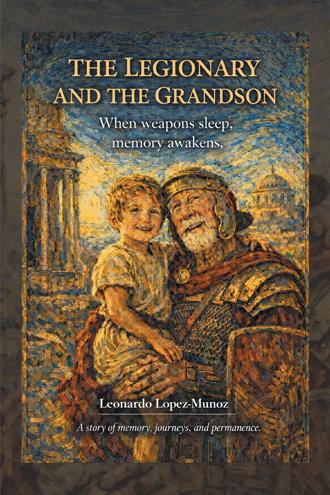
The Legionary and The Grandson
When weapons sleep, memory awakens
by
Book Cover & Preview Text
Formats

Book Details
About the Book
A Roman legionary, marked by war and the arena, reaches the end of his life in Emerita Augusta, the city founded for the veterans of the Empire. There, when sword and shield finally rest, he chooses to tell his story to the only heir who truly matters: his grandson.
Through his voice—soldier, gladiator, veteran—a world in constant motion unfolds: campaigns on the Empire’s frontiers, combat in the arena, camaraderie, loss, and finally the most difficult lesson of all—the lesson of staying. The grandson listens, grows, and in time sets out on his own journey northward, toward Roman Gallaecia and the origins of Ourense, where history is no longer measured by conquest, but by endurance.
From first-century Rome to nineteenth-century Ourense, passing through centuries of silent continuity, this book traces the possible memory of a family that did not stand out for domination, but for resisting time. A story in which empires fall, names change, and surnames blend—yet the thread does not break.
The Legionary and the Grandson is more than a historical novel. It is a story about transmission—about what is inherited when violence ends and only the word remains. A book about how, when weapons sleep, memory awakens.
About the Author
Leonardo López Muñoz is an author driven by deep thought and a persistent question about origins. His interest
does not arise from a desire to glorify the past, but to understand it: to observe how small decisions, repeated
over time, can sustain a family line for centuries.
From an early age, he showed a natural inclination toward reflection, memory, and history—not as a
succession of great deeds, but as a silent fabric woven from ordinary lives. This perspective led him to study the history of the
places where his family put down roots: Emerita Augusta, the Roman city founded for veterans of the Empire, and Ourense,
heir to Aquis Auriense, shaped more by continuity than by rupture.
In The Legionary and the Grandson, the author brings together two realms that rarely meet: documented history and
possible history. Drawing on archives, family records, and verifiable historical data—especially from the eighteenth century
onward—Leonardo López Muñoz builds a narrative bridge backward, linking those facts with a plausible historical fiction that
spans from the second century through the early modern era.
The result is not a closed genealogy nor an absolute claim, but a fictional yet deeply probable transition, in which the
novel becomes a tool to explore what documentation cannot state, but historical context allows us to imagine. The Roman
legionary, his grandson who walks north, and the generations that remain are not documentary certainties, but an honest
narrative hypothesis, constructed with respect, coherence, and long memory.
Ultimately, this book is a reflection on permanence: on how families do not always survive by standing out, but by staying,
adapting, and continuing. And on how history belongs not only to those who conquered, but also to those who, century after
century, chose not to break the chain.